Lessons & Reforms
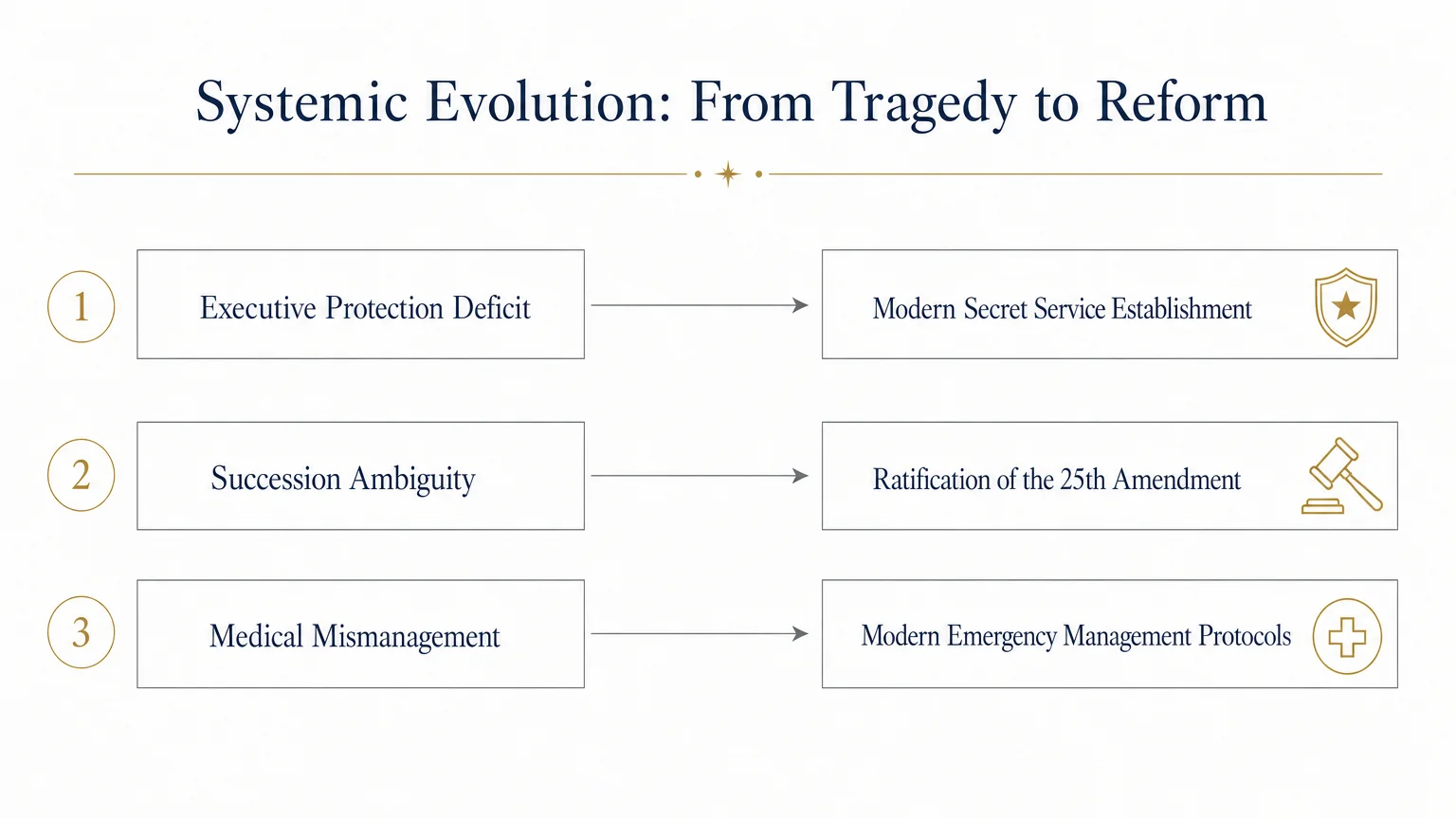
The historical data from these eight presidential deaths drove some of the most critical constitutional and policy reforms in American history. The most profound structural change materialized as the Twenty-Fifth Amendment to the United States Constitution. Ratified in 1967, four years after the Kennedy assassination, this amendment formalized the “Tyler Precedent” set after Harrison’s death in 1841. More importantly, it established a concrete legal framework for declaring a president medically incapacitated. Prior to this, when Garfield lingered near death for months, the country lacked any legal mechanism to transfer power temporarily. The Twenty-Fifth Amendment functions as the ultimate governmental contingency plan, ensuring that the command structure remains intact even during severe, prolonged medical emergencies.
Federal employment and institutional management also underwent sweeping reforms following a presidential death. The assassination of James A. Garfield directly targeted the corruption and inefficiency of the “spoils system,” where political loyalty dictated civil service appointments. Garfield’s assassin, Charles Guiteau, was an erratic, rejected job seeker who believed he deserved a diplomatic post. Recognizing the systemic danger of this patronage system, Congress passed the Pendleton Civil Service Reform Act of 1883. This legislation created a merit-based infrastructure for federal employment, significantly reducing the chaotic and hazardous environment of patronage seekers aggressively lobbying the executive branch.
The evolution of protective preparedness stands as the most visible lesson learned from these tragedies. The modern United States Secret Service operates as a direct response to the systemic security failures that killed Lincoln, Garfield, and McKinley. Congress officially mandated the Secret Service to protect the president in 1906. Over the following decades, the agency transitioned from an anti-counterfeiting bureau into an elite protective apparatus. Following the Kennedy assassination, threat intelligence sharing among federal agencies underwent massive reform to prevent known, high-risk individuals from operating near the executive perimeter. You can trace every modern magnetometer, motorcade route sweep, and rooftop countersniper deployment directly back to the operational failures of past assassinations.
Medical preparedness within the executive branch completely transformed. The delayed, uncoordinated medical responses to Lincoln and McKinley, combined with the fatal hygiene failures surrounding Garfield, forced the institutionalization of executive healthcare. The modern White House Medical Unit provides continuous, immediate trauma care and comprehensive physiological monitoring. The unit maintains access to an independent blood supply and highly specialized medical personnel at all times. By applying the rigorous principles of root cause analysis to the deaths of Harding and FDR, contemporary medical teams prioritize preventative cardiovascular monitoring, ensuring that silent biological hazards no longer threaten the stability of the executive office.