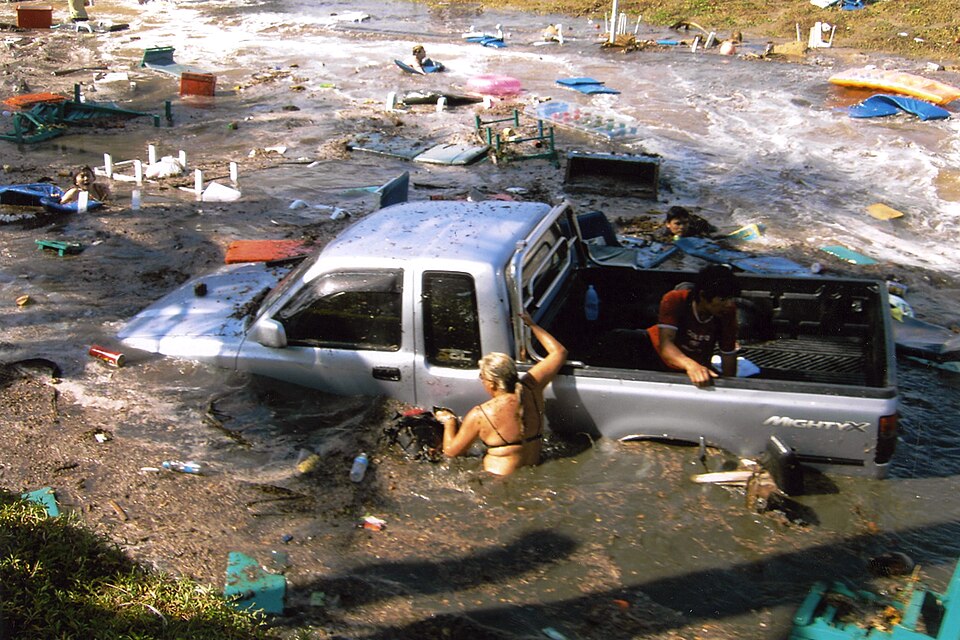
Causes and Mechanisms of Devastation
Understanding the deadliest disasters requires a foundational knowledge of the scientific forces that drive them. Earthquakes, tsunamis, and floods originate from distinct geological and atmospheric processes, but their potential for destruction is often magnified by similar factors, such as population density and the lack of warning.
The Science of Earthquakes
Earthquakes are caused by the sudden release of energy in the Earth’s crust, creating seismic waves. This energy is most often released along faults, which are fractures between blocks of rock. The theory of plate tectonics explains that the Earth’s outer shell is divided into several plates that glide over the mantle. The majority of the world’s earthquakes occur at the boundaries where these plates interact.
It is crucial to distinguish between an earthquake’s magnitude and its intensity. Magnitude, measured on a logarithmic scale like the Moment Magnitude Scale (Mw), quantifies the total energy released at the earthquake’s source, or hypocenter. Each whole number increase on the scale represents approximately 32 times more energy release. Intensity, on the other hand, describes the effects of the shaking at a specific location, measured by scales like the Modified Mercalli Intensity (MMI) scale. An earthquake has only one magnitude, but its intensity can vary greatly depending on distance from the epicenter, local geology, and building construction quality. Soft soils, for example, can amplify seismic waves, leading to much higher intensity and greater damage than on solid bedrock. Credible seismic hazard information can be found through agencies like the USGS.
The Formation of Tsunamis
A tsunami is a series of powerful ocean waves most commonly caused by large-scale disturbances of the seafloor, such as earthquakes, volcanic eruptions, or underwater landslides. They are fundamentally different from normal ocean waves, which are generated by wind. A tsunami wave involves the movement of the entire water column, from the seafloor to the surface.
The most destructive tsunamis are generated by major undersea earthquakes at subduction zones, where one tectonic plate is forced beneath another. A “megathrust” earthquake, like the one that caused the 2004 Indian Ocean event, can cause the seafloor to abruptly uplift or subside, displacing a massive volume of water. In the deep ocean, the tsunami travels at speeds exceeding 500 miles per hour, with a very long wavelength and a low wave height that is often unnoticeable. As the wave enters shallower coastal waters, its speed decreases and its height increases dramatically, creating the towering wall of water associated with a tsunami. An effective early warning system, like the DART (Deep-ocean Assessment and Reporting of Tsunamis) buoys monitored by organizations like NOAA/NWS, is the key to providing timely evacuation alerts.
The Dynamics of Catastrophic Floods
Flooding is the overflow of water that submerges land that is usually dry. The deadliest floods in history have been riverine floods, also known as fluvial floods, which occur when a river’s channel cannot contain the rate of water flow. The causes are often a combination of factors, including prolonged, intense rainfall, rapid snowmelt, and the failure of man-made water control structures like levees or dikes.
The 1931 China floods were a textbook example of a cascading sequence of hazards. The disaster began with a severe winter that produced heavy snow deposits in the river basins. This was followed by a spring thaw and record-breaking heavy rains in the summer, driven by an unusually active cyclone season. The already-strained rivers, particularly the Yangtze and Huai, swelled beyond capacity. The immense pressure led to the catastrophic failure of dikes, many of which were poorly maintained. This released a massive volume of water across the flat, densely populated floodplains, turning millions of square miles into an inland sea. This highlights how both natural extremes and human infrastructure failures are root causes of such events.