Causes & Mechanisms
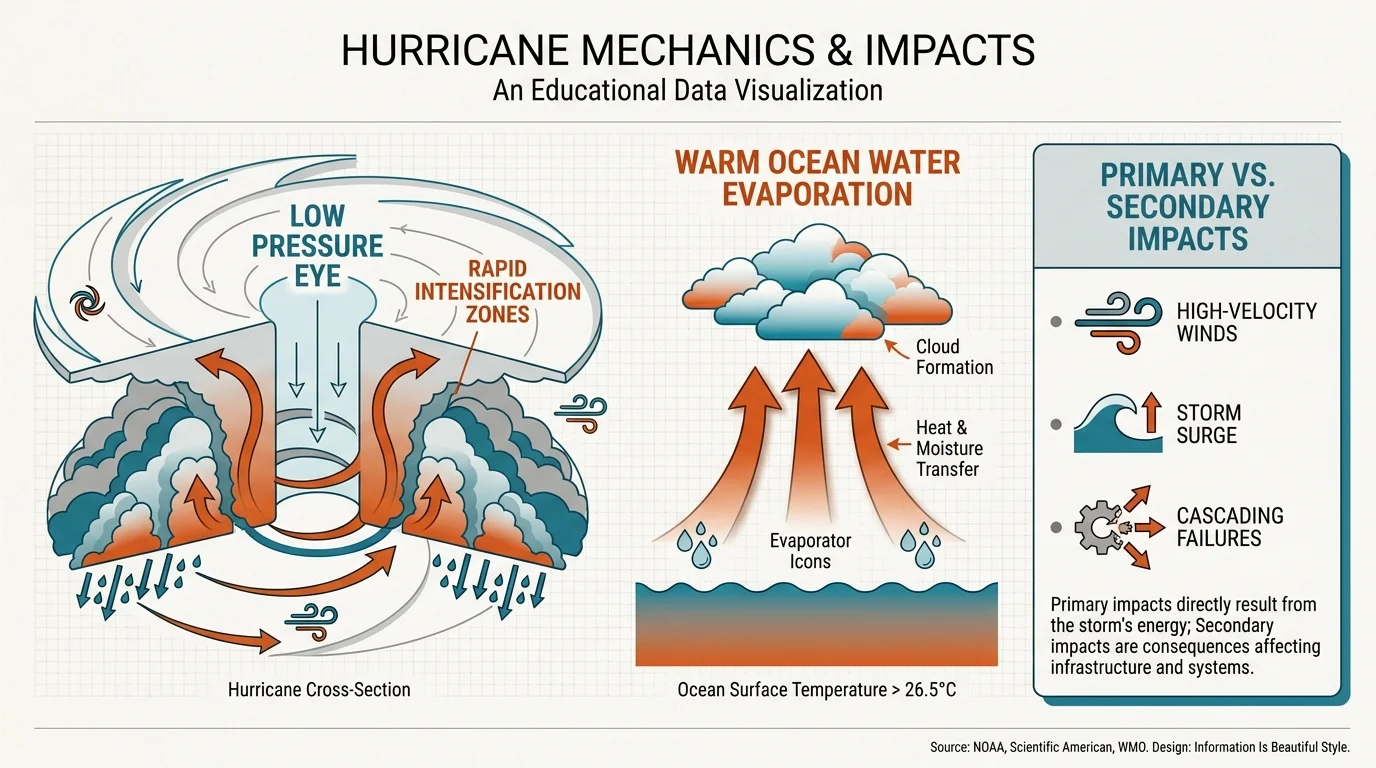
To grasp why these ten hurricanes caused such profound historical shifts, you must understand the hazard science and the specific physical mechanisms driving their destruction. Hurricanes are essentially massive heat engines. They extract latent heat from warm ocean waters and convert it into kinetic energy. When sea surface temperatures exceed 79 degrees Fahrenheit, and atmospheric conditions feature low wind shear, a tropical disturbance can organize into a terrifyingly efficient vortex.
Meteorologists differentiate between a storm’s magnitude—its absolute energy and physical size—and its intensity, which is measured by its maximum sustained winds and lowest central barometric pressure. The Saffir-Simpson Hurricane Wind Scale, a direct outcome of the lessons learned from Hurricane Camille, categorizes storms from Category 1 to Category 5 based on these sustained wind speeds. However, while wind determines the category, water produces the highest mortality rates.
Storm surge is the abnormal rise of water generated by a storm, over and above the predicted astronomical tides. It is driven primarily by the sheer force of hurricane winds pushing ocean water toward the coast, combined with the suction effect of extreme low atmospheric pressure. As an example of this mechanism, consider the 1969 impact of Hurricane Camille on the Mississippi Gulf Coast. Camille struck with a central pressure of 900 millibars and estimated sustained winds of 175 miles per hour. This immense kinetic force piled the waters of the Gulf of Mexico against the shallow continental shelf, producing a staggering 24-foot storm surge. The incredible mass and velocity of this water completely obliterated coastal structures that had survived decades of lesser storms.
Another crucial mechanism altering modern disaster history is rapid intensification. This occurs when a tropical cyclone’s maximum sustained winds increase by at least 35 miles per hour within a 24-hour period. You can observe a concrete example of this phenomenon in the mechanics of Hurricane Ian in 2022. As Ian moved over the deeply warm waters of the Gulf of Mexico, its central pressure plummeted. In just 24 hours, Ian’s sustained winds exploded from 115 mph to 160 mph. This rapid escalation severely compressed the window for emergency managers to issue evacuation orders, leaving coastal residents in Lee County, Florida, with minimal time to escape the ensuing 15-foot surge.
Hydrology also plays a dominant role, particularly when storm systems stall over landmasses. Hurricane Harvey in 2017 broke modern hydrological models. Instead of moving inland and dissipating, Harvey became trapped between two high-pressure systems. The storm continuously drew moisture from the exceptionally warm Gulf and dumped it over the highly urbanized, impervious surfaces of the Houston metropolitan area. Harvey dropped over 60 inches of rain in specific localized gauges. The local bayous and flood control reservoirs—specifically the Addicks and Barker reservoirs, designed for mid-20th-century climate expectations—reached absolute capacity, forcing engineers into a highly controversial controlled release that inundated thousands of downstream homes.
The interaction between these extreme meteorological hazards and human infrastructure dictates the scale of the disaster. A storm only becomes a historical catastrophe when the physical mechanism—whether it is wind uplift forces tearing a roof apart, a surge undermining a foundation, or a stalled system overwhelming a watershed—exceeds the engineering thresholds of the built environment. Understanding these mechanisms allows you to recognize the precise vulnerabilities in your own community’s defenses.