Timeline
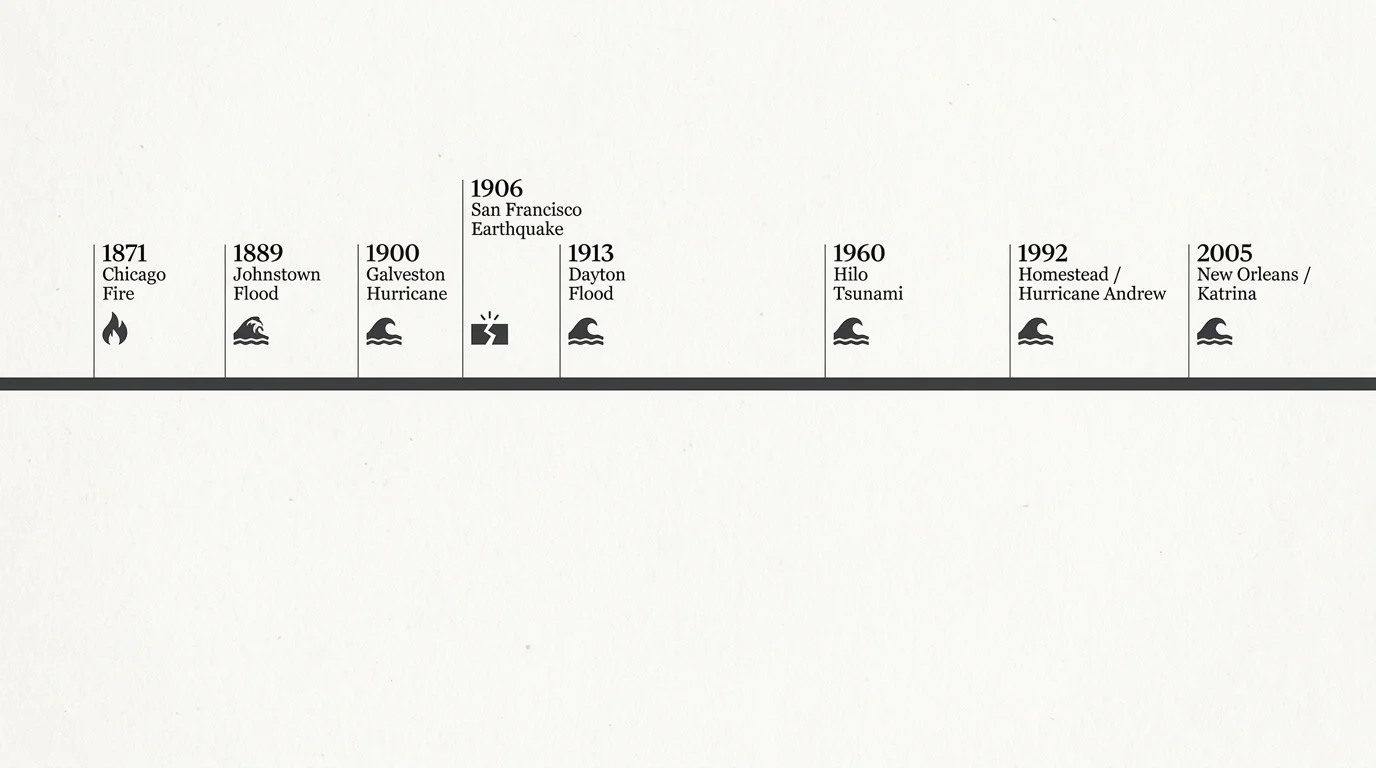
Tracking the chronology of these near-fatal disasters reveals how quickly modern infrastructure can collapse under natural pressures. The timeline of American urban disasters begins with the Great Chicago Fire in October 1871. The fire ignited on the evening of October 8 and spread rapidly due to a severe summer drought and strong southwesterly winds. Over the next 36 hours, the fire systematically consumed the central business district, only dying out when rain began to fall late on October 10. Just eighteen years later, on May 31, 1889, the residents of Johnstown experienced an entirely different timeline of destruction. Heavy rains had pounded the region for days, but the true disaster unfolded in less than an hour. The South Fork Dam breached at 3:10 PM. A massive wall of water, traveling at speeds up to 40 miles per hour, rushed down the valley and completely obliterated Johnstown by 4:07 PM.
The dawn of the 20th century introduced even larger-scale urban catastrophes. The Galveston hurricane struck on September 8, 1900. Throughout the early afternoon, steadily rising waters cut off all bridges to the Texas mainland. By 8:00 PM, the storm surge reached its terrifying peak, submerging the entire island and erasing thousands of homes in darkness before the storm finally moved inland the following morning. Six years later, San Francisco faced an immediate crisis. At 5:12 AM on April 18, 1906, the earth violently shook for roughly 45 to 60 seconds. However, the earthquake merely marked the beginning of the timeline. The ensuing firestorm raged uncontrollably for three full days, systematically destroying the city block by block until it was finally contained on April 21.
During the mid-20th century, distant seismic events threatened American shores. The coastal city of Hilo suffered devastating tsunamis twice within a single generation. On April 1, 1946, an earthquake in the Aleutian Islands sent seismic sea waves across the Pacific, striking Hilo with little to no official warning and sweeping away its waterfront. Fourteen years later, on May 23, 1960, a massive earthquake off the coast of Chile generated another tsunami. Despite the existence of a newly established warning system that sounded sirens hours in advance, mixed messaging and a lack of public understanding caused many residents to ignore the alerts, resulting in another tragic timeline of nighttime destruction.
Modern disasters demonstrated that sophisticated forecasting could not always prevent infrastructure failure. Hurricane Andrew developed rapidly in August 1992. By the time it made landfall in South Florida just south of Miami at 5:00 AM on August 24, it had intensified into a compact but monstrously powerful Category 5 storm. The extreme winds scoured Homestead for just a few terrifying hours, but those hours permanently altered the city’s trajectory. Similarly, the timeline of Hurricane Katrina in 2005 showcased a slow-motion catastrophe. While the hurricane made landfall on the morning of August 29, the most severe devastation in New Orleans occurred throughout the following afternoon and into August 30, as various levees and floodwalls systematically failed, slowly filling the city over a period of 48 hours and triggering a month-long desperate rescue and recovery operation.