Lessons & Reforms
The absolute destruction of these eight cities forced critical evaluations of existing safety paradigms, leading to vital reforms that protect you today. When investigating how a disaster occurs, root cause analysis consistently reveals that human policy and engineering standards frequently lag behind known geological and meteorological risks. The practical lessons extracted from these tragedies have systematically improved global community resilience.
Following the 1889 Johnstown flood, immense public outrage over the dam’s failure fueled significant legal reforms. The disaster challenged the existing legal doctrine of fault-based liability, eventually contributing to the widespread adoption of strict liability in American law. This legal concept means that property owners who engage in ultra-hazardous activities, such as maintaining a massive private dam, can be held legally responsible for resulting damages regardless of their demonstrated negligence.
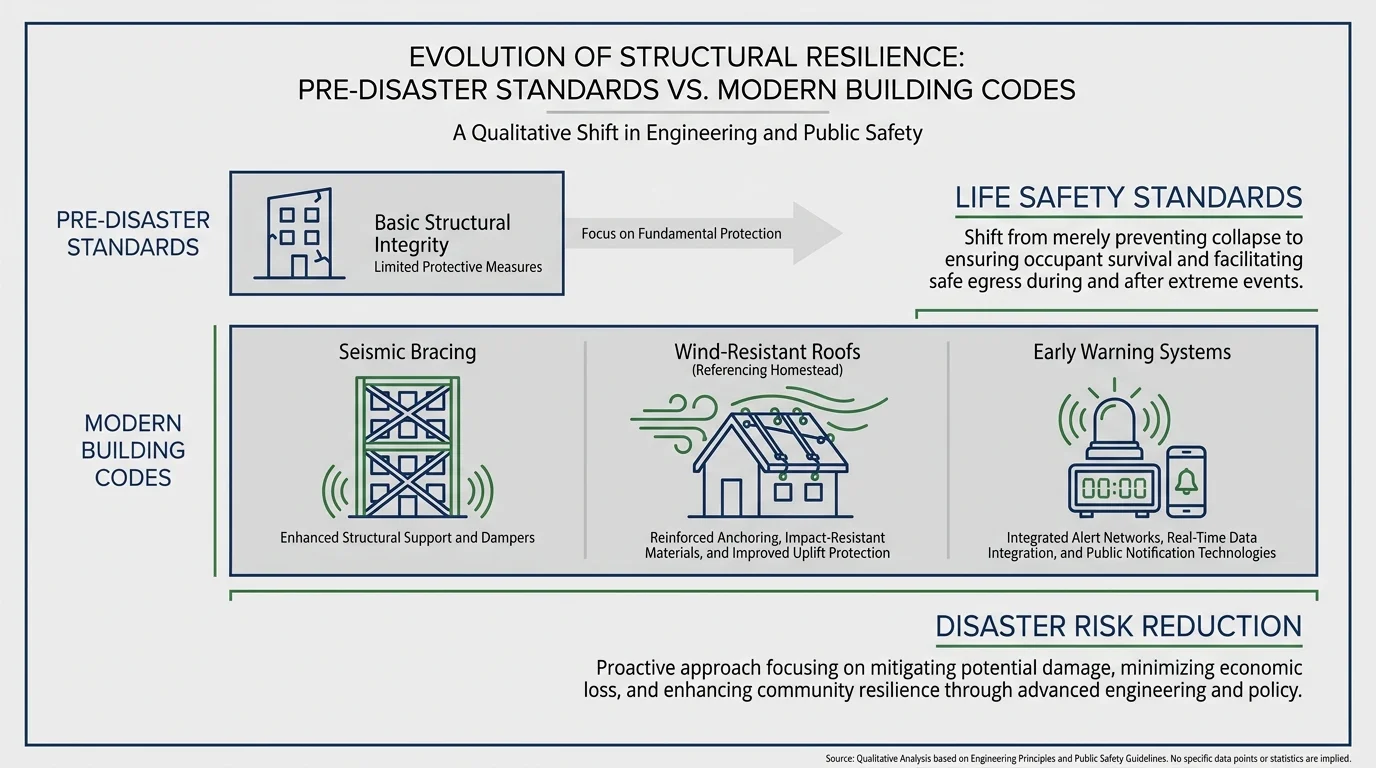
The destruction of Homestead by Hurricane Andrew triggered one of the most profound shifts in building codes in American history. Extensive investigations revealed that poor inspection processes and inadequate roof tie-downs caused the vast majority of the damage. In response, Florida adopted the highly restrictive South Florida Building Code, which mandated shatterproof windows, reinforced roof trusses, and strict wind-load engineering standards. These strict regulations significantly reduced structural damage during subsequent hurricanes and served as a baseline model for coastal communities nationwide.
In California, the legacy of the 1906 San Francisco earthquake eventually influenced the passage of the Alquist-Priolo Earthquake Fault Zoning Act decades later. This legislation prevents the construction of buildings meant for human occupancy directly on the surface traces of known, active faults. Furthermore, the disaster demonstrated the critical need for redundant water systems for firefighting, prompting San Francisco to build an independent auxiliary water supply system specifically engineered to operate after violent seismic shaking.
Emergency guidance at the FEMA and hazard science at the USGS and NOAA/NWS.
Public health information at the CDC and the WHO. Environmental data via the EPA.
Transport and workplace investigations via the NTSB and OSHA. Risk reduction resources at the UNDRR.
Despite these extensive engineering and policy changes, many communities remain at risk. Urban sprawl continuously pushes residential developments into wildland-urban interfaces prone to extreme fires and floodplains vulnerable to intense precipitation. The recoveries of Galveston, Greensburg, and New Orleans prove that successful hazard mitigation requires continuous financial investment in both hardened infrastructure and comprehensive community education.