
Causes & Mechanisms
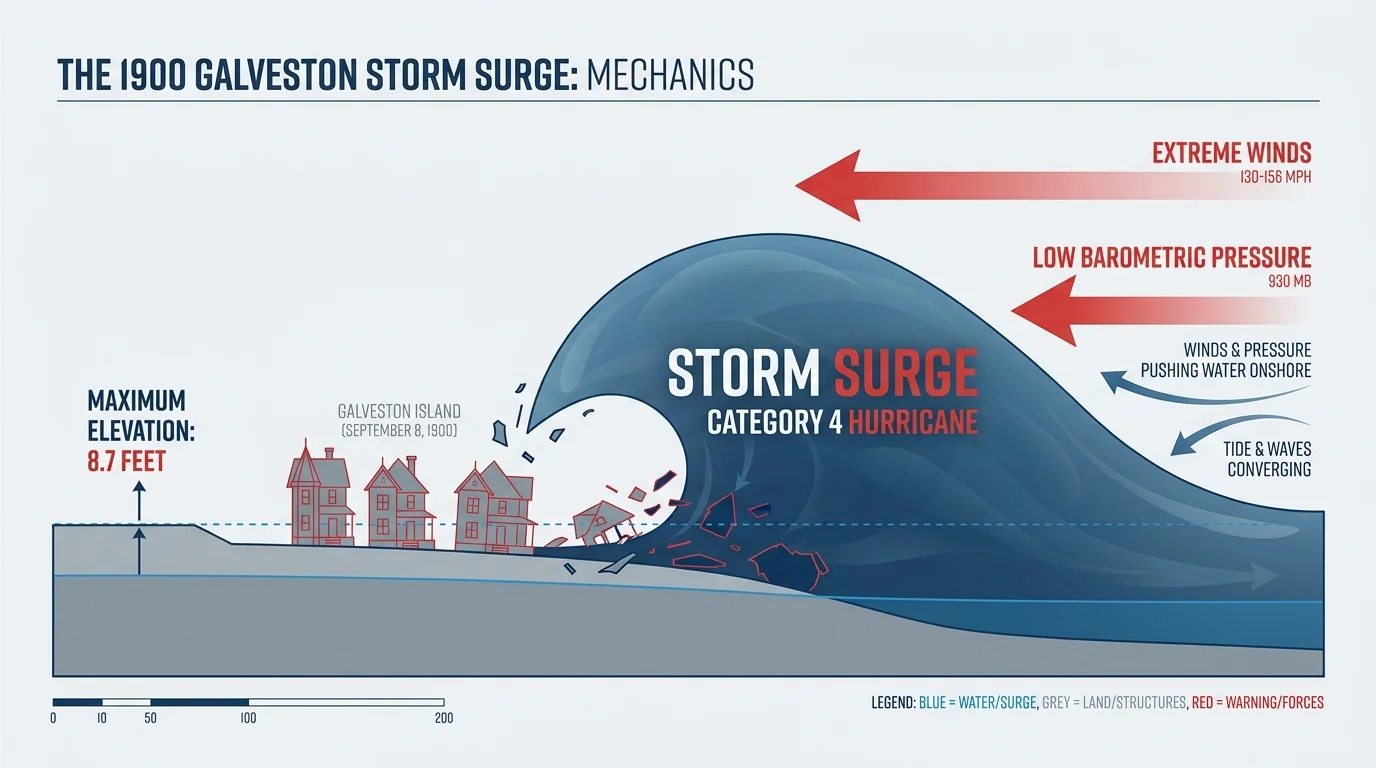
To understand how these cities nearly vanished, you must examine the underlying hazard science and system failures that triggered their darkest hours. Disasters involve a complex interplay of meteorological, seismological, and hydrological forces overcoming human engineering. In meteorology, storm surge represents the abnormal rise in seawater generated by a storm, over and above the predicted astronomical tides. When you look at the 1900 Galveston hurricane, you can see a perfect worked example of storm surge mechanics overwhelming natural topography. The island possessed a maximum elevation of just 8.7 feet above sea level. A Category 4 hurricane approached, pushing a massive dome of ocean water ahead of its path. Driven by extreme winds and low barometric pressure, the storm generated a 15-foot surge. By subtracting the island’s maximum elevation from the surge height, you find that even the highest points of the city were submerged under at least 6.3 feet of moving ocean water, while lower areas faced inundation exceeding 10 feet. This physical mechanism battered wooden structures off their unanchored foundations and turned the resulting debris into a violent battering ram that swept the island clean.
Another primary mechanism involves wind load failure during extreme atmospheric events. When Hurricane Andrew struck Homestead in 1992, structural engineers witnessed a catastrophic demonstration of aerodynamic forces tearing a city apart. As sustained winds hit 165 mph, they created massive positive pressure on the windward walls of homes. Simultaneously, air accelerating over the roofs generated severe negative pressure, acting exactly like an airplane wing to create upward aerodynamic lift. In a standard unreinforced residential structure, once a window or door breaches, internal pressure spikes dramatically. You can calculate this as a sudden pressurization event; the combined external suction and internal expansion push roof trusses upward and exterior walls outward, leading to instantaneous explosive collapse. This exact aerodynamic failure left Homestead looking as though a bomb had detonated in every neighborhood.
Seismology provides equally destructive mechanisms. San Francisco faced total ruin in 1906 due to massive tectonic stress release along the San Andreas Fault. You must distinguish between magnitude, which measures the total energy released at the earthquake’s source, and intensity, which measures the strength of shaking at a specific location. The 1906 earthquake possessed an estimated magnitude of 7.9, but its intensity was magnified by the soft, water-saturated soils beneath the city’s reclaimed waterfront. This caused soil liquefaction, a process where violent shaking causes water-logged sediment to temporarily lose its strength and act like a liquid. Buildings simply sank or collapsed as the ground beneath them lost all bearing capacity. Furthermore, the violent ground displacement sheared underground water mains and gas lines, immediately setting the stage for the secondary impact of uncontrollable urban conflagration.
Hydrological disasters often stem from a combination of extreme weather and engineering failures. In Johnstown in 1889, runoff from an unprecedented multi-day rainstorm filled Lake Conemaugh to its physical limits. The earthen South Fork Dam lacked a spillway capable of handling the excessive volume. Once the water overtopped the dam crest, it quickly eroded the structural face, leading to a total catastrophic breach. A similar hydrological mechanism struck Dayton in 1913, when an atmospheric river dumped up to 11 inches of rain over a frozen, completely saturated watershed. The frozen ground possessed zero infiltration capacity, meaning 100 percent of the rainfall became immediate surface runoff. The resulting volume of water easily overwhelmed the channel capacity of the Great Miami River. Decades later, New Orleans faced a different hydrological nightmare during Hurricane Katrina in 2005. The city, built largely below sea level, relied on an intricate levee system. When storm surge entered the canals, it exerted lateral water pressure that exceeded the design limits of the floodwalls, causing the soil foundations beneath the walls to slide and fail, allowing millions of gallons of lake water to fill the city like a bowl.