Causes & Mechanisms
To grasp why certain extreme weather events cause hundreds of billions of dollars in damage, you must first understand the underlying scientific mechanisms and hazard science. Natural disasters impact communities through physical forces that overwhelm existing engineering limits. Meteorologists and structural engineers analyze these forces meticulously to understand exactly how structures fail under extreme stress.
The Dynamics of Tropical Cyclones
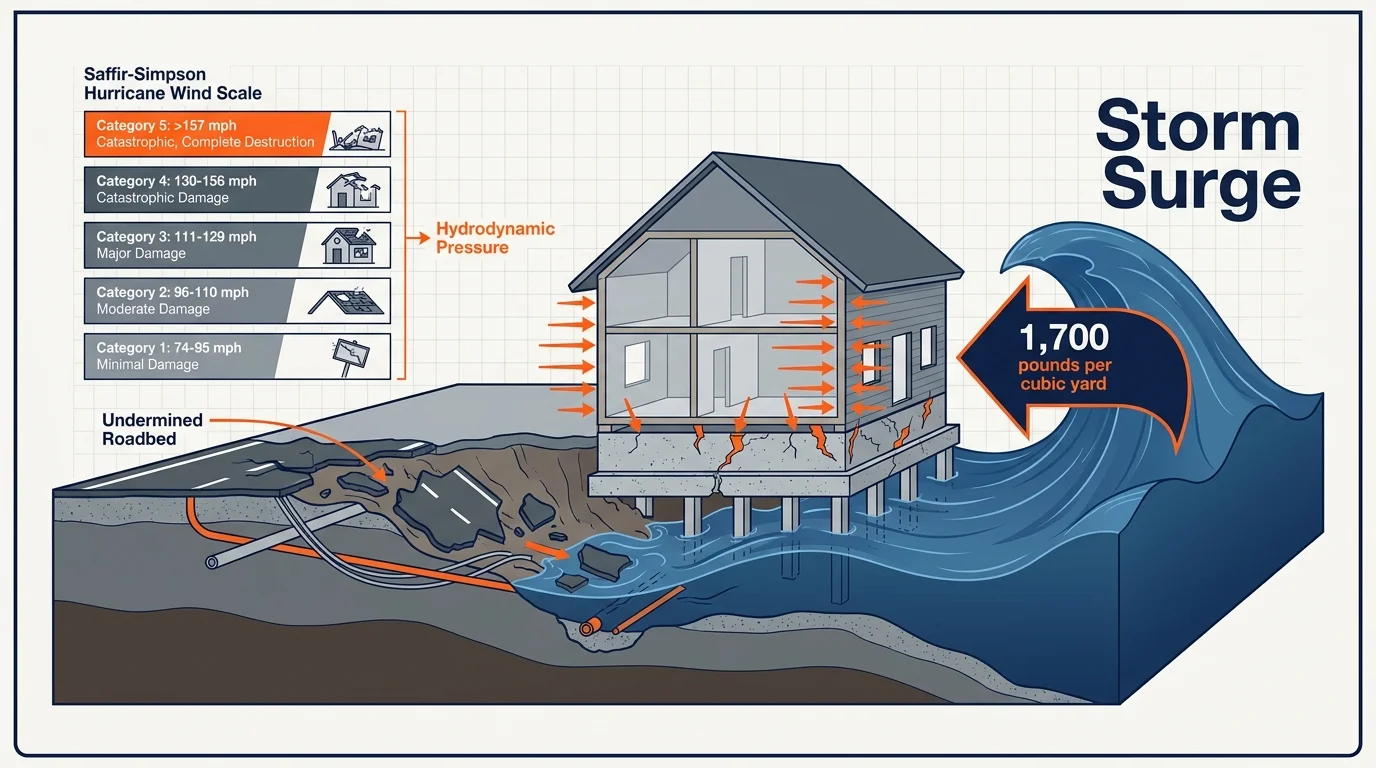
Hurricanes consistently rank as the most destructive financial events in the United States. To understand their impact, you need to differentiate between magnitude vs. intensity. In disaster science, intensity refers to the physical strength of the hazard—such as the maximum sustained wind speed measured by the Saffir-Simpson Hurricane Wind Scale. Magnitude, in the context of economic impact, refers to the total financial loss incurred. A highly intense storm striking a barren coastline yields a low economic magnitude, whereas a moderately intense storm striking a major metropolitan hub results in an enormous financial magnitude.
The primary driver of coastal destruction is storm surge. You can define storm surge as the abnormal rise in seawater level generated by a storm, primarily driven by strong, persistent winds pushing oceanic water toward the shore. Unlike regular tides, a storm surge operates like a massive bulldozer of water, arriving with immense hydrodynamic pressure. When a storm surge flows into an estuary or a densely populated bay, it literally pushes buildings off their foundations, undermines roadbeds, and inundates critical utilities. Water weighs approximately 1,700 pounds per cubic yard; therefore, even a slow-moving storm surge physically batters infrastructure with forces that standard residential construction simply cannot withstand.
Atmospheric Stalling and Extreme Precipitation
Wind and surge are not the only mechanisms driving catastrophic costs. Inland flooding caused by stalled weather systems represents a growing mechanism of financial devastation. You can observe a perfect operational example of this mechanism by looking at the thermodynamics of Hurricane Harvey. Meteorologists use the Clausius-Clapeyron relationship to explain this phenomenon. This physical law states that for every 1 degree Celsius increase in atmospheric temperature, the air can hold approximately 7 percent more water vapor. Because the Gulf of Mexico waters were anomalously warm in 2017, the atmosphere absorbed an immense volume of moisture.
When Harvey made landfall, the steering currents in the upper atmosphere collapsed, causing the storm to stall over southeastern Texas for several days. Combining the stalled movement with the hyper-saturated air mass dictated by the Clausius-Clapeyron equation, the storm continuously pulled moisture from the Gulf and dumped it over the Houston metropolitan area. Some local rain gauges measured over 60 inches of precipitation. The sheer volume of water overwhelmed the regional hydrological capacity, filling reservoirs to the brim and turning interstate highways into raging rivers. This thermodynamic mechanism perfectly illustrates why extreme rainfall events generate historic economic losses.
Wildfire and Winter Storm Dynamics
Away from the coasts, you find that specific topographical and atmospheric conditions drive the costliest wildfires and winter storms. In California, the collision of prolonged drought, heavy accumulation of combustible vegetation, and high-velocity seasonal winds—like the Diablo and Santa Ana winds—creates a terrifying fire mechanism. These winds rush down mountain slopes, compressing and heating up as they descend. When a spark ignites during a high-wind event, the fire spreads across thousands of acres in a matter of hours, consuming entire towns before massive evacuation orders can even be fully executed.
Conversely, the mechanics of catastrophic winter storms often involve disruptions of the stratospheric polar vortex. When the high-altitude bands of wind that normally keep arctic air trapped near the North Pole weaken, massive lobes of freezing air plunge deep into the southern United States. Because infrastructure in states like Texas and Louisiana lacks the deep-freeze insulation standard in northern regions, these polar vortex disruptions cause cascading failures in power generation and water distribution, leading to tens of billions of dollars in damage.