Causes & Mechanisms
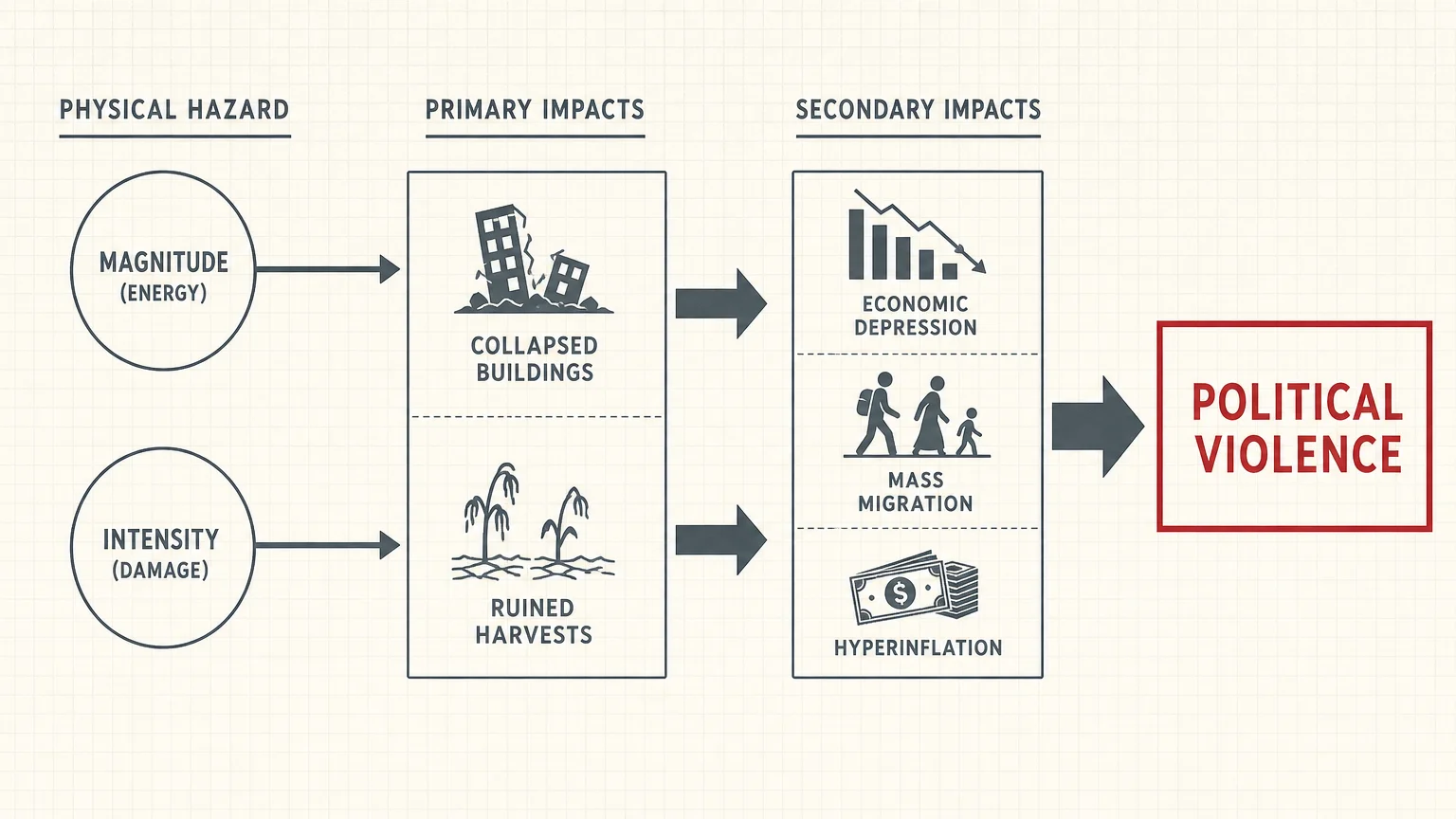
To understand how a disaster transforms into a war, you must distinguish between the physical hazard and the systemic failure it triggers. In seismology and meteorology, scientists measure the raw energy of an event. However, the social impact depends entirely on a region’s resilience. The magnitude of an earthquake measures the energy released at the source, while the intensity measures the localized ground shaking and damage. High-intensity events striking areas with poor engineering or corrupt leadership produce severe primary impacts, such as collapsed buildings and ruined harvests. These rapidly evolve into secondary impacts, including economic depression, mass migration, and ultimately, political violence.
The 1972 Managua Earthquake and the Sandinista Revolution
On December 23, 1972, a magnitude 6.2 earthquake struck Managua, Nicaragua. While the magnitude was moderate, the intensity proved catastrophic because the epicenter occurred at a shallow depth directly beneath the capital. The seismic waves instantly destroyed the city’s poorly constructed adobe and unreinforced masonry buildings. The primary impact left over ten thousand people dead and displaced hundreds of thousands. However, the secondary impact caused the war. Dictator Anastasio Somoza embezzled an estimated thirty million dollars in international relief funds, selling donated emergency supplies for personal profit. This overt corruption delegitimized his regime entirely, driving enraged citizens to join the Sandinista National Liberation Front. The earthquake acted as the specific mechanism that escalated a simmering resistance into a full-scale revolution.
The 2006-2010 Syrian Drought and the Civil War
Hydrological disasters often generate slower, yet equally destructive, mechanisms for war. Between 2006 and 2010, the Fertile Crescent experienced the most severe multi-year drought in its recorded history. Root cause analysis links this extreme lack of precipitation to widespread agricultural collapse. The region suffered a seventy-five percent crop failure rate, and eighty-five percent of the livestock perished. Over one and a half million rural farmers abandoned their barren land and migrated to urban centers like Aleppo and Damascus. This sudden influx overwhelmed urban infrastructure, driving up food prices and unemployment. The government’s failure to provide adequate social safety nets transformed a meteorological drought into intense socio-economic desperation, providing the direct spark for the 2011 Syrian uprisings and the subsequent, devastating civil war.
The 1628-1644 Ming Dynasty Droughts and Peasant Rebellions
In the early seventeenth century, China experienced a brutal sequence of prolonged droughts. The hydrological failure dried up major waterways, including sections of the Grand Canal, severely disrupting the transport of grain. As agricultural output plummeted, mass starvation set in. Rather than providing relief, the Ming Dynasty government increased taxes to fund military defenses against northern invaders. This mechanism of compounding famine with exorbitant taxation broke the social contract. Starving peasants formed massive rebel armies under leaders like Li Zicheng. The environmental stress completely undermined the state’s military readiness and internal cohesion, directly causing the internal collapse of the Ming Dynasty and facilitating the violent Qing conquest.
The 1989-1993 Rwandan Drought and the 1994 Genocide
In Rwanda, a combination of severe localized drought and plunging global coffee prices created an economic and environmental mechanism for catastrophe. In the late 1980s and early 1990s, the lack of rainfall significantly reduced crop yields in a country heavily dependent on subsistence agriculture. Land scarcity became an existential threat for rural families. Political elites manipulated this intense resource competition, redirecting the population’s economic anxiety into ethnic hatred. The government systematically blamed the Tutsi minority for the country’s socio-economic collapse. The drought acted as an environmental accelerant, creating a desperate, land-hungry populace that extreme political factions mobilized to execute the tragic 1994 genocide and ignite the First Congo War.