Infrastructure & Environmental Effects
Natural disasters wage war against the built environment. The destruction of buildings, transportation networks, and utility grids paralyzes recovery efforts and inflicts long-lasting environmental damage. By examining the structural ruins left behind by these eight disasters, engineers learned precisely how to fortify modern infrastructure against immense physical forces.
The 1933 Long Beach Earthquake explicitly demonstrated the fatal flaw of unreinforced masonry construction. Unreinforced masonry refers to brick or concrete block walls built without internal steel reinforcement bars. When the earthquake shook Southern California, the lateral forces easily broke the brittle mortar joints of these structures. Over 120 public school buildings suffered catastrophic structural failure, effectively pancaking into heaps of loose brick. This specific type of structural vulnerability became the primary target for early seismic engineers.
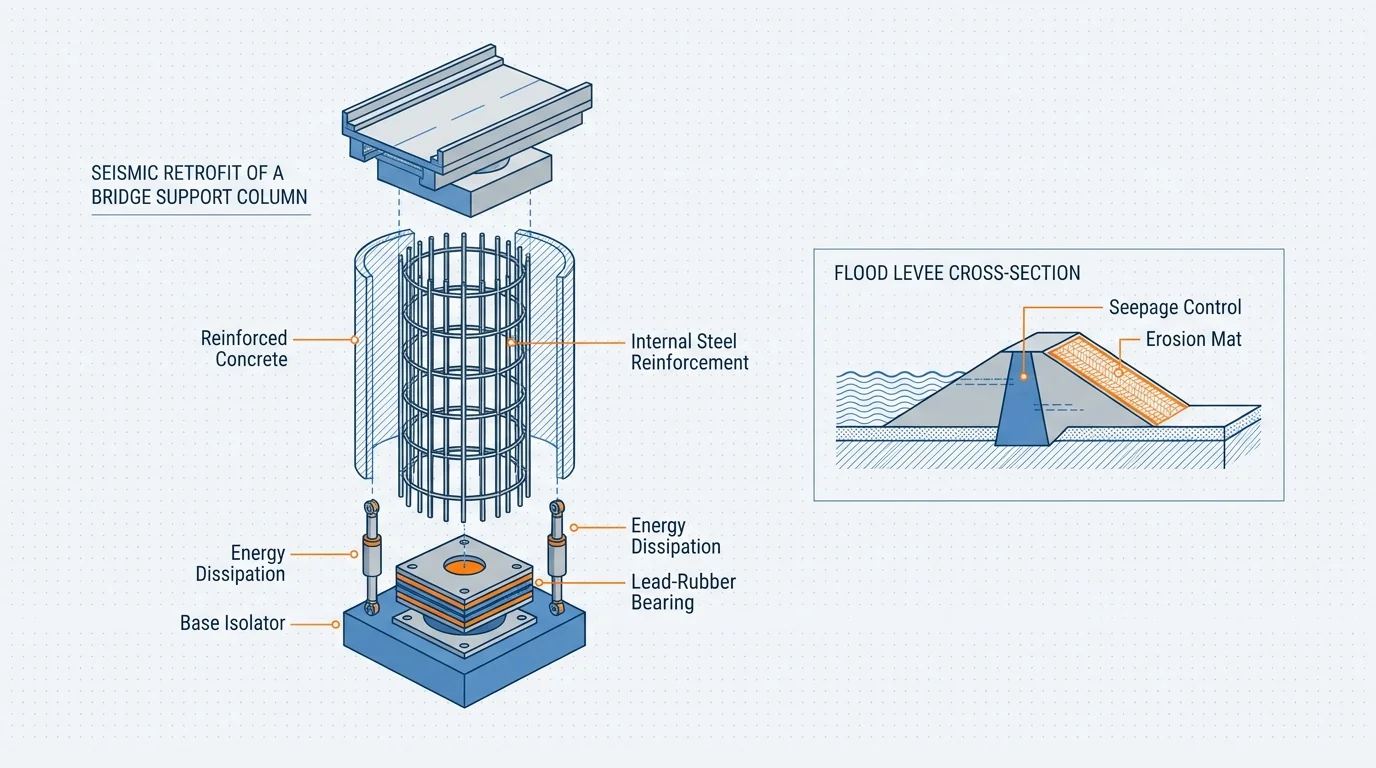
Transportation infrastructure faced its most severe test during the 1989 Loma Prieta earthquake. The collapse of the double-deck Cypress Street Viaduct in Oakland highlighted the dangers of resonant frequency and inadequate column confinement. The soft soil beneath the highway amplified the seismic waves, causing the heavy upper deck to sway violently. Because the concrete support columns lacked sufficient steel wrapping, the concrete shattered under the stress, causing the upper deck to crush the lower deck. This catastrophic failure forced engineers to completely rethink how they design elevated highways to remain flexible under seismic loads.
Wind damage took center stage during Hurricane Andrew in 1992. The storm generated sustained winds of 165 mph, subjecting suburban infrastructure to incredible aerodynamic forces. Entire subdivisions in Homestead, Florida, experienced total devastation. Post-storm investigations revealed massive failures in modern construction practices. Wind sheer easily ripped away poorly secured roof shingles, exposing thin oriented strand board (OSB) sheathing. Once the wind penetrated the building envelope, the internal pressure increased dramatically, blowing out windows and forcing structural walls to collapse outward. Andrew proved that a single weak link in a building’s exterior easily leads to total structural failure.
Environmental contamination compounds the difficulty of infrastructure recovery. During the 1906 San Francisco Earthquake, broken water mains not only prevented firefighters from stopping the inferno but also mixed raw sewage with the city’s drinking water, creating severe sanitation hazards. The environmental aftermath of Hurricane Katrina proved infinitely worse. When the floodwaters inundated New Orleans and the surrounding industrial corridors, they mixed with millions of gallons of spilled crude oil from damaged refineries, heavy metals from submerged vehicles, and toxic household chemicals. This toxic stew coated the city in a hazardous sludge, requiring extensive environmental remediation before citizens could safely rebuild their homes. The disaster underscored the necessity of securing hazardous material storage sites against extreme flood events.