Timeline
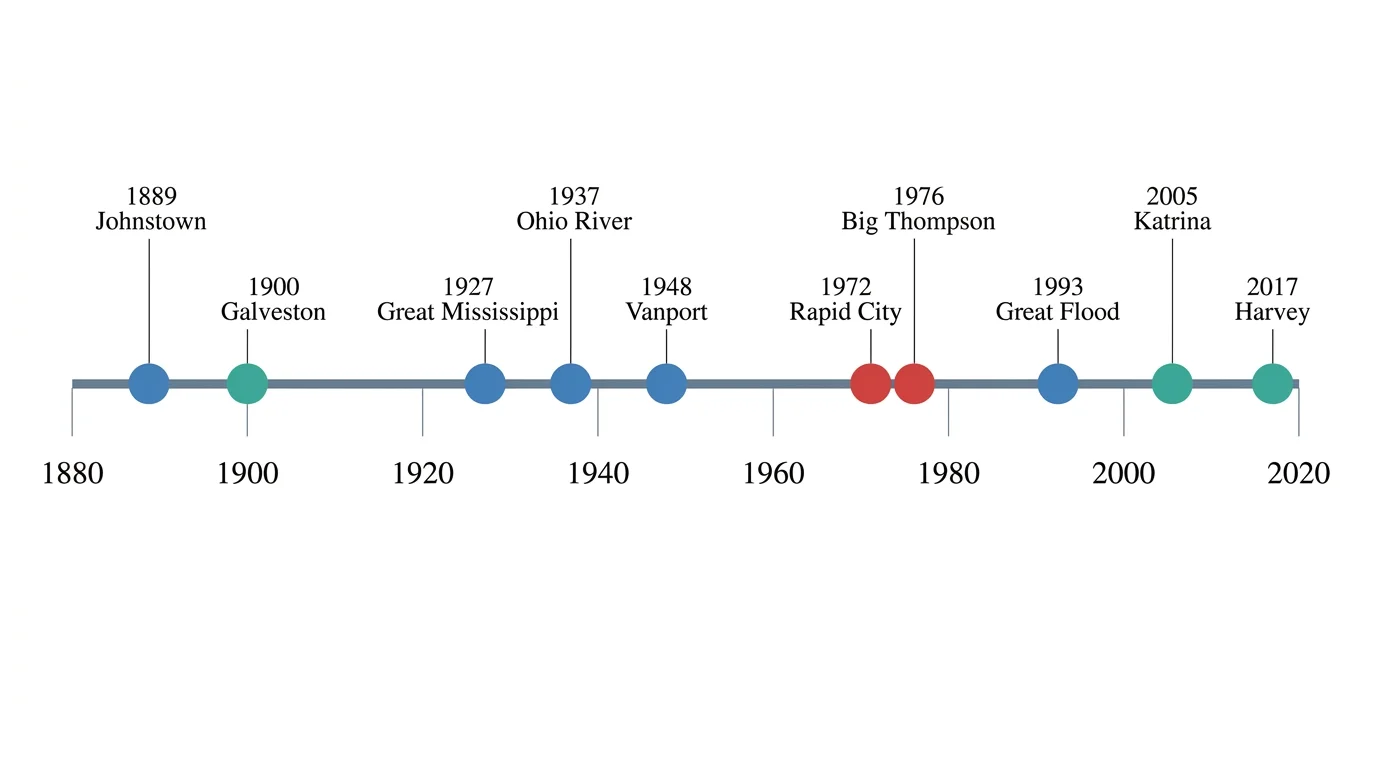
The timeline of these ten historic floods traces the evolution of modern disaster response and American infrastructure. The era of industrial expansion set the stage for early tragedies. On May 31, 1889, days of heavy rain filled Lake Conemaugh in Pennsylvania. At 3:10 PM, the South Fork Dam collapsed. The resulting surge decimated Johnstown within an hour, marking one of the first times the nation collectively mobilized for disaster relief, largely led by Clara Barton and the newly formed American Red Cross.
A little over a decade later, on September 8, 1900, the Great Galveston Hurricane struck the Texas coast. Without modern satellite warnings, the city was caught completely unprepared for the 15-foot storm surge that swept over the island in the late afternoon and evening. This event remains the deadliest natural disaster in United States history and prompted Galveston to entirely raise its city elevation and construct its famous seawall over the ensuing decade.
During the spring of 1927, months of heavy rainfall caused the Mississippi River to swell to historic proportions. On April 15, 1927, the river achieved record crests, and over the following weeks, levees breached in 145 different locations across several states. The timeline of this flood stretched for months, inundating 27,000 square miles and keeping vast tracts of land submerged well into the summer. Just ten years later, in January 1937, the Ohio River experienced a similar prolonged disaster. Continuous rain from late December through January caused the river to crest in Cincinnati at nearly 80 feet, halting the entire regional economy and plunging riverfront cities into darkness as power plants failed.
The mid-twentieth century brought abrupt, localized tragedies that changed individual states instantly. On Memorial Day, May 30, 1948, the Columbia River—swollen by heavy snowmelt and spring rain—broke through a railroad embankment protecting the city of Vanport, Oregon. Within hours, the city, originally built to house wartime shipyard workers, was completely destroyed and never rebuilt. The timeline of rapid destruction continued in the 1970s. On June 9, 1972, massive thunderstorms stalled over the Black Hills of South Dakota, causing the Canyon Lake Dam to fail and flooding Rapid City under the cover of darkness. Just four years later, the aforementioned Big Thompson Canyon flood struck Colorado on the eve of the state’s centennial celebrations in July 1976.
The modern era of flooding is defined by complex infrastructure failures battling unprecedented weather anomalies. The Great Flood of 1993 unfolded in agonizingly slow motion. Rains began in the spring, but the disaster reached its peak between June and August when the Mississippi and Missouri rivers simultaneously crested at record heights. Floodwaters remained over the region for roughly 200 days in some areas. In contrast, the timeline for Hurricane Katrina in 2005 involved a rapid sequence of systemic failures. The storm made landfall on August 29, 2005. While the initial wind damage was severe, the true disaster unfolded over the next 48 hours as the levee system protecting New Orleans failed, resulting in 80 percent of the city flooding. Finally, in late August 2017, Hurricane Harvey systematically drowned Houston and surrounding counties over a grueling four-day period, demonstrating that even with advanced warning, infrastructure cannot always handle the sheer volume of climate-driven rainfall.