Human Impact & Response
When you look beyond the architectural ruin of these famous landmarks, you confront immense human tragedies. Because historic monuments, palaces, and towering viewpoints naturally attract large crowds, their sudden collapse frequently triggers a massive mass casualty incident—a situation where the sheer volume of severe injuries rapidly overwhelms local medical resources and emergency management teams. Historic structures built long before modern safety codes offer minimal protection to their occupants, transforming public squares into epicenters of devastation.
The 2010 earthquake in Haiti serves as the most devastating modern example. The collapse of the National Palace symbolized the broader destruction of Port-au-Prince, where hundreds of thousands of unreinforced concrete block homes failed instantly. Authorities estimate the death toll exceeded 100,000 people. The destruction of government infrastructure paralyzed the initial emergency response, forcing international search and rescue teams, military units, and humanitarian organizations to coordinate a massive airlift operation. Local residents used bare hands and simple tools to excavate survivors from the rubble of major landmarks, demonstrating immense community resilience in the face of absolute systemic failure.
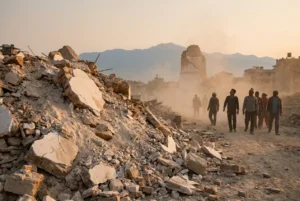
In Nepal during the 2015 Gorkha earthquake, the human toll directly associated with historic landmarks was profoundly concentrated. The Dharahara Tower held tremendous cultural significance, and on that Saturday afternoon, its observation deck and interior stairs were packed with sightseers. When the tower collapsed, nearly 200 people perished within that single structure. Across the region, the earthquake claimed nearly 9,000 lives. Emergency management authorities faced extreme challenges navigating the narrow, rubble-choked streets of Kathmandu’s historic Durbar Square to reach trapped victims and establish triage centers.
Public health crises inevitably follow the destruction of major civic centers. When aqueducts, modern water mains, and sanitation systems rupture, displaced survivors face severe risks from waterborne diseases. Whether it was the survivors of the 1692 Port Royal earthquake facing outbreaks of tropical diseases in temporary camps, or the citizens of Port-au-Prince battling a devastating cholera epidemic months after their earthquake, the secondary health impacts often prolong the suffering. Managing these post-disaster environments requires rapid deployment of clean water, field hospitals, and epidemiological tracking to prevent further loss of life among the displaced population.
Public health information at the CDC and the WHO. Environmental data via the EPA.