
Timeline
The historical record of catastrophic storms begins with the Great Hurricane of the Antilles in October 1780. Striking the Caribbean during the height of the American Revolution, this incredibly violent system remains the deadliest Atlantic hurricane on record. The hurricane spent several days tearing through Barbados, Martinique, and St. Eustatius. Observers noted that the winds stripped the bark entirely off mature trees, a phenomenon meteorological engineers estimate requires wind speeds well over 200 miles per hour. The storm decimated British and French naval fleets, drowning thousands of sailors and pushing the total death toll beyond 22,000.
Moving into the nineteenth century, the Coringa Cyclone struck the eastern coast of India in November 1839. The thriving port city of Coringa sat highly exposed on the Godavari River delta. A massive tropical cyclone drove a 40-foot storm surge directly into the harbor, snapping the mooring lines of roughly 20,000 ships and driving the vessels inland into residential districts. The surge completely destroyed the city and instantly drowned approximately 300,000 people. Officials ultimately deemed the region too hazardous for a major port, and Coringa was never rebuilt to its former commercial glory.
Three decades later, the Backergunge Cyclone of October 1876 devastated the coastal regions of present-day Bangladesh. Striking the Meghna River estuary, the cyclone arrived perfectly synced with the astronomical high tide. The resulting storm surge swept deeply inland, drowning around 100,000 people almost instantly. In the weeks that followed, an additional 100,000 individuals perished from starvation and cholera outbreaks as the saltwater surge contaminated all regional freshwater supplies and ruined the rice harvest.
In October 1881, the Haiphong Typhoon struck the Gulf of Tonkin in modern-day Vietnam. The storm devastated the city of Haiphong and the surrounding low-lying coastal areas. Much like the Bay of Bengal, the Gulf of Tonkin acts as a funnel for storm surges. The ensuing inundation drowned approximately 300,000 people, obliterating entire coastal farming communities and reshaping the regional coastline.
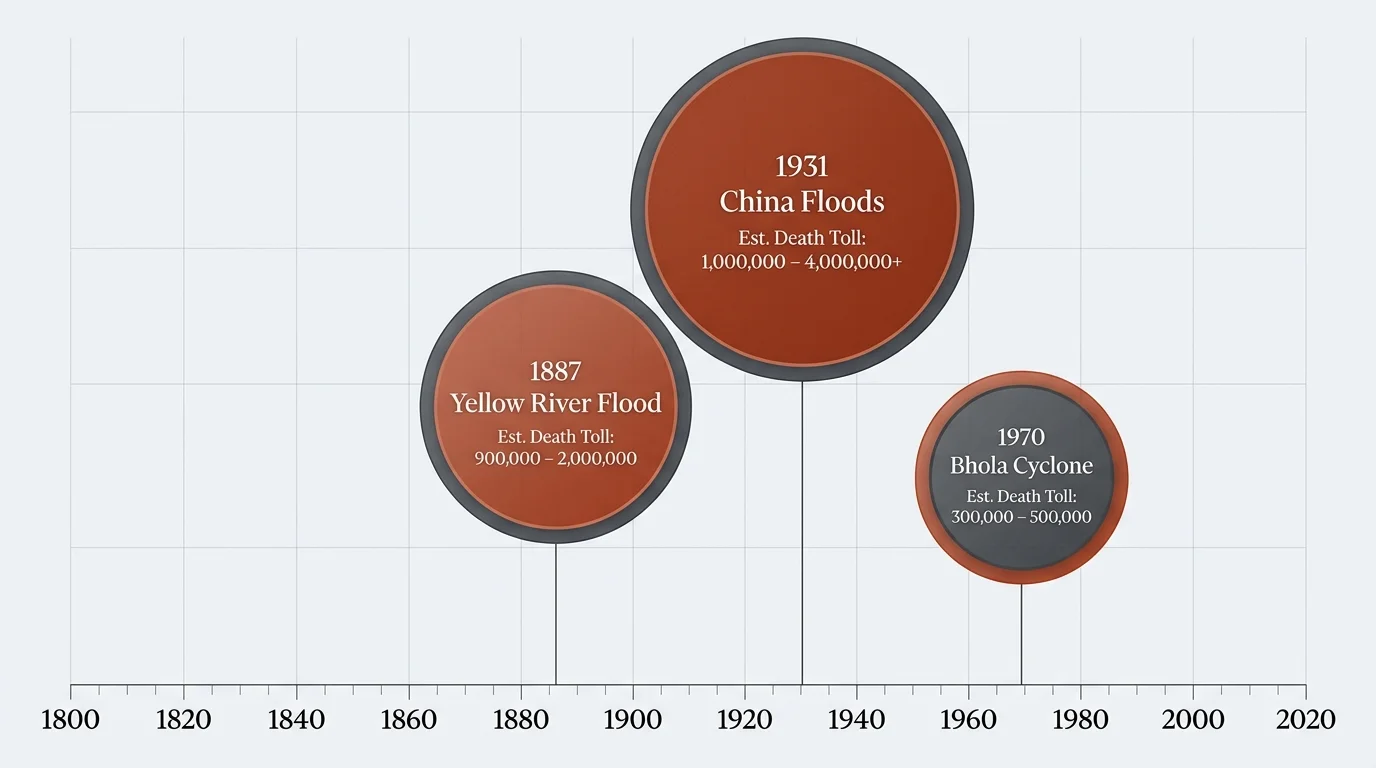
Shifting from cyclones to river floods, the Yellow River Flood of September 1887 remains one of the most catastrophic infrastructural failures in history. Centuries of levee building in China’s Henan province elevated the Yellow River far above the surrounding plains. Following days of torrential rain, the dikes breached near the city of Huayuankou. The river spilled out over 50,000 square miles of densely populated farmland. Estimates indicate that the flooding and subsequent famine killed between 900,000 and 2 million people.
The summer of 1931 brought the deadliest weather disaster in recorded human history: the 1931 China Floods. Following a prolonged drought, heavy winter snows melted rapidly in the spring. Subsequently, an abnormally active monsoon season dropped relentless rain across the Yangtze, Huai, and Yellow River basins. In July alone, the region absorbed the impact of seven major typhoons. The combined waterways overtopped their banks, creating an inland sea roughly the size of the state of New York. The drowning, widespread starvation, and sweeping epidemics of typhus and cholera resulted in a staggering death toll estimated between 1 million and 4 million people.
In November 1970, the Bhola Cyclone devastated the Ganges Delta in East Pakistan, which is modern-day Bangladesh. Despite meteorological stations tracking the storm, the archaic warning system failed to communicate the extreme risk to the remote island communities. The cyclone struck at night, pushing a massive storm surge over the delta and killing between 300,000 and 500,000 people. The sluggish federal response to this disaster heavily fueled the ongoing political tensions that directly sparked the Bangladesh Liberation War the following year.
August 1975 brought Typhoon Nina to central China. After moving inland, a cold front blocked the typhoon, causing it to stall over Henan Province. The storm unleashed unprecedented rainfall that overloaded the regional reservoir system, causing the catastrophic collapse of the Banqiao Dam and 61 downstream dams. The resulting wall of water obliterated entire cities. Government secrecy obscured the disaster for decades, but modern estimates place the combined death toll from drowning, famine, and disease between 171,000 and 230,000.
In April 1991, another devastating system, known formally as the 1991 Bangladesh Cyclone, struck the Chittagong region. Packing winds of 155 miles per hour, the storm drove a 20-foot surge over the southeastern coast. Despite improvements in early warning systems since the Bhola disaster, many residents lacked access to concrete cyclone shelters. The storm claimed an estimated 138,000 lives, underscoring the lethal gap between receiving a warning and having a safe place to take refuge.
Finally, Cyclone Nargis struck the Irrawaddy Delta of Myanmar in May 2008. The storm rapidly intensified before making landfall, pushing a catastrophic surge up the densely populated river delta. The government severely mishandled the disaster response and initially blocked international humanitarian aid. Consequently, the combination of immediate drowning and delayed medical collapse killed approximately 138,000 people, marking the deadliest natural disaster in the history of Myanmar.