Causes & Mechanisms
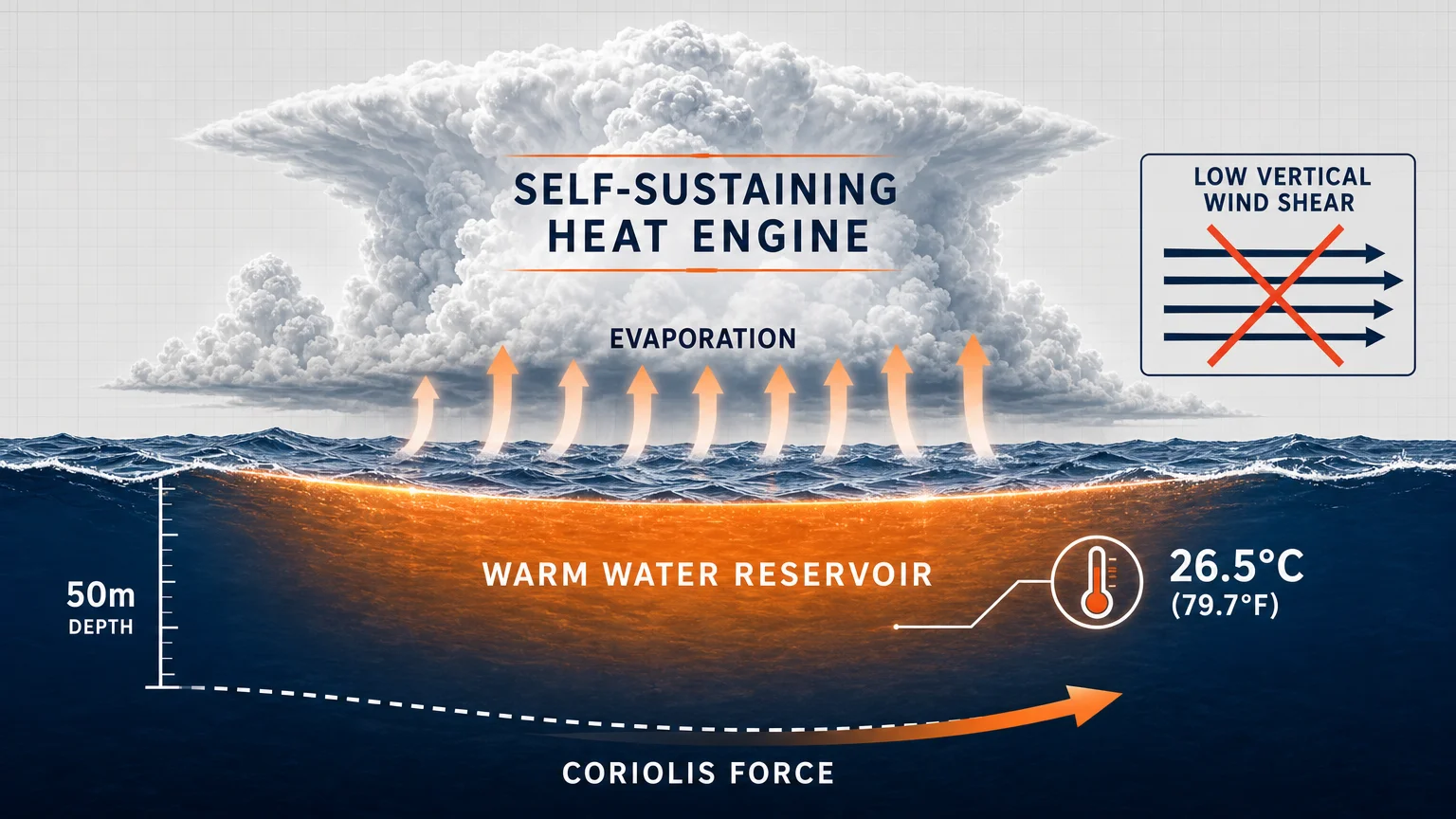
To understand how a tropical storm achieves catastrophic potential, you must look at the specific atmospheric and oceanic conditions that fuel cyclogenesis. Tropical cyclones require ocean water temperatures of at least 26.5 degrees Celsius (79.7 degrees Fahrenheit) spanning a depth of roughly 50 meters. This deep reservoir of warm water acts as the primary thermal engine for the storm. As the warm water evaporates, it rises into the atmosphere and cools, condensing into massive thunderstorm clouds. This condensation process releases latent heat, which warms the surrounding air, lowers the surface barometric pressure, and forces even more moisture upward. You are essentially witnessing a massive, self-sustaining heat engine.
For this heat engine to organize into a devastating cyclone, the atmosphere requires low vertical wind shear. Vertical wind shear refers to the change in wind speed and direction at varying altitudes. If the wind shear is too strong, it literally rips the developing thunderstorms apart, preventing the storm from organizing its central core. When wind shear remains low, the system can stack vertically, intensifying rapidly. As the Earth rotates, the Coriolis force deflects these inflowing winds, imparting the characteristic spin of the cyclone. Without the Coriolis force—which is why these storms rarely form within five degrees of the equator—the low-pressure center would simply fill with air and dissipate.
While meteorologists categorize storms by their sustained wind speeds, you must recognize the distinction between primary and secondary impacts. The primary impact involves the direct mechanical destruction caused by high winds. Extreme winds tear roofs from buildings, uproot ancient trees, and turn ordinary debris into lethal projectiles. However, historical data consistently proves that the secondary impacts—specifically storm surge and inland freshwater flooding—cause the overwhelming majority of fatalities.
Storm surge serves as the deadliest weapon in a tropical cyclone’s arsenal. You can understand storm surge mechanics by looking at the interaction between wind, atmospheric pressure, and the ocean floor. The cyclonic winds physically push a massive dome of ocean water toward the shore. Simultaneously, the extremely low barometric pressure in the eye of the storm allows the ocean surface to bulge upward. When this massive volume of water reaches a shallow continental shelf, the sloping seafloor acts as a ramp. The water has nowhere to go but up and inland, creating a sudden, catastrophic rise in sea level that easily overwhelms coastal defenses. A concrete example of this mechanism occurred during the 1970 Bhola Cyclone, where wind dynamics and a shallow delta combined to push a 10.4-meter wall of water across Bangladesh, demonstrating exactly how fatal this oceanic displacement becomes.