Lessons & Reforms
The history of disaster management is written in the aftermath of tragedy. The fundamental purpose of analyzing these ten hurricanes is to extract the hard-earned lessons and implement reforms that protect your life and property today. Every major shift in how the United States prepares for, communicates, and responds to natural disasters can be directly traced back to the failures exposed by these specific storms.
Following the utter devastation of the 1900 Galveston Hurricane, civic leaders realized that simply rebuilding the city as it was would guarantee a repeat disaster. They engineered one of the most ambitious protective infrastructure projects in American history: the Galveston Seawall. Furthermore, engineers literally raised the elevation of the entire island by pumping in millions of cubic yards of sand beneath existing structures. This proactive reform shifted the municipal mindset from passive acceptance of weather risks to active environmental modification.
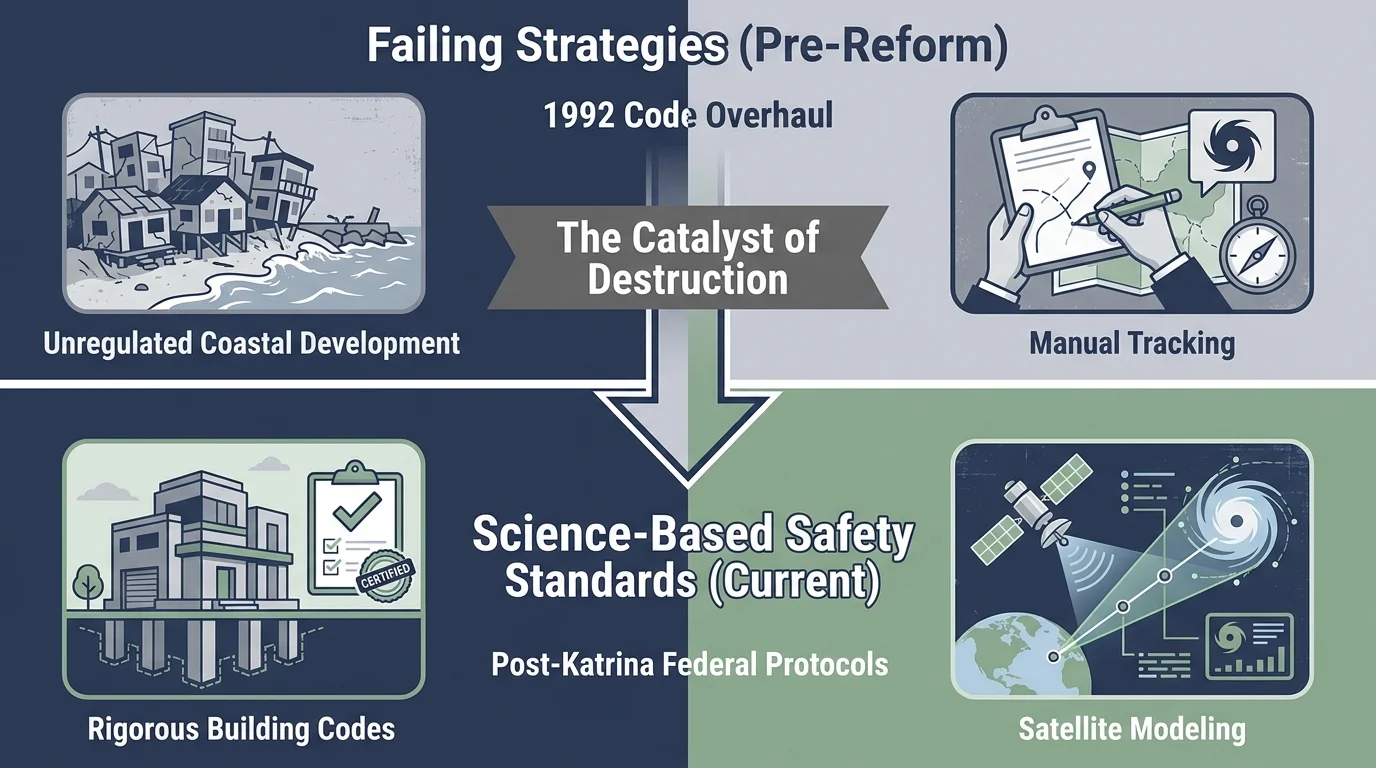
The creation of the South Florida Building Code, which eventually evolved into the statewide Florida Building Code, was the direct regulatory reform born from Hurricane Andrew. By identifying the exact mechanisms of structural failure, engineers mandated impact-resistant windows, reinforced garage doors, and strict load-path continuity from roof to foundation. Consider the practical effect: when Hurricane Charley struck Florida in 2004 with winds similar to Andrew, homes built under the new code sustained dramatically less structural damage compared to their older neighbors. This concrete example proves that stringent regulations, while increasing initial construction costs, save billions of dollars in long-term recovery.
Hurricane Katrina exposed critical flaws in federal and state coordination. The disastrous delay in deploying resources led Congress to pass the Post-Katrina Emergency Management Reform Act of 2006. This legislation completely reorganized the Federal Emergency Management Agency (FEMA). It granted the agency the authority to pre-position resources and deploy strike teams without waiting for a formal request from a overwhelmed state governor. This procedural reform drastically reduced the response time for delivering food, water, and medical care in subsequent disasters.
Advancements in meteorology and public warning systems were catalyzed by the communication failures of earlier storms. Hurricane Camille’s catastrophic impact pushed the adoption of the Saffir-Simpson Hurricane Wind Scale to give the public a clear, numerical understanding of a storm’s threat level. More recently, the flooding disasters of Hurricane Sandy and Hurricane Harvey forced the National Hurricane Center to overhaul how it communicates water-related risks. Because the wind-based category system failed to convey the danger of storm surge and inland flooding, forecasters introduced explicit Storm Surge Watches and Warnings, utilizing high-resolution inundation mapping to show you exactly how deep the water might get on your specific street.
Hurricane Maria highlighted the lethal consequences of ignoring supply chain vulnerabilities in island and isolated communities. The primary lesson learned was that resilience cannot rely entirely on external rescue operations. Communities must develop internal redundancies. This has spurred funding for localized microgrids, secure satellite communication backups, and decentralized stockpiles of medical essentials.
Finally, Hurricane Ian emphasized the urgent need to address climate-driven risk factors. As sea levels rise and oceans warm, the probability of rapid intensification and higher storm surges increases. The lessons from Ian are currently forcing municipalities to rethink their zoning laws, pushing new developments further inland and utilizing buyout programs to return the most vulnerable coastal properties to natural wetlands. Protecting your community now requires acknowledging that historical safety buffers are no longer sufficient against the changing physics of modern hurricanes.
Emergency guidance at the FEMA and hazard science at the USGS and NOAA/NWS.
Public health information at the CDC and the WHO. Environmental data via the EPA.
Transport and workplace investigations via the NTSB and OSHA. Risk reduction resources at the UNDRR.
Disclaimer: This article is intended for informational and historical purposes only and does not constitute emergency management or safety advice. Meteorological conditions, building codes, and emergency guidance change frequently. Always verify your local risk protocols and evacuation routes with official agencies and local authorities.