Causes & Mechanisms
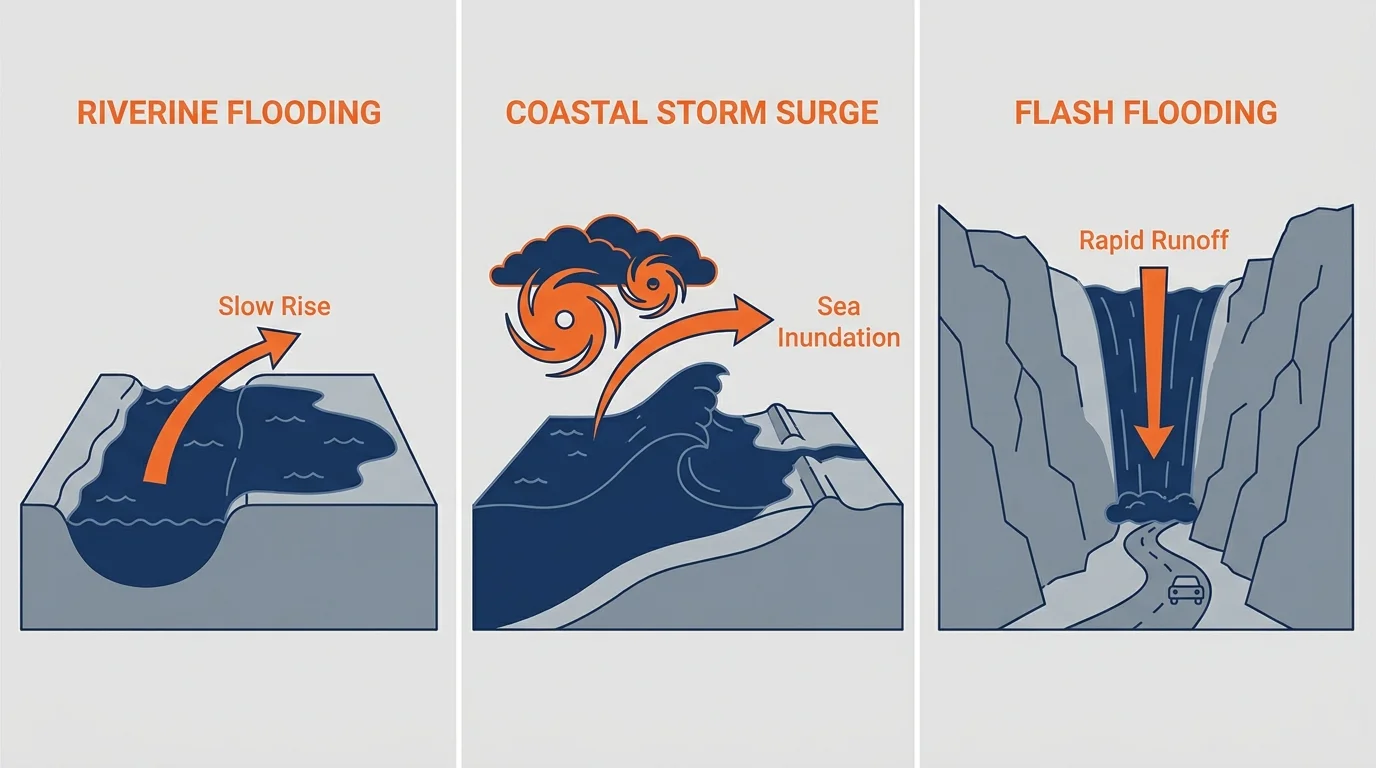
To fully grasp why these ten floods changed states forever, you must understand the underlying hazard science. Flooding generally falls into three main categories: riverine flooding, coastal storm surge, and flash flooding. Riverine flooding occurs when sustained rainfall or rapid snowmelt overwhelms a river channel, causing it to spill into adjacent floodplains. Coastal storm surge—the mechanism behind the devastating 1900 Galveston disaster and 2005 Hurricane Katrina—happens when high winds from a tropical cyclone push a massive wall of ocean water onto the shore. Flash flooding, meanwhile, is characterized by a rapid, extreme rise in water levels, often occurring within hours of intense rainfall over specific topography.
The physical mechanisms that drive these events rely on a combination of meteorological triggers and ground conditions. Meteorologists closely monitor atmospheric rivers, which are long, narrow bands of concentrated moisture in the atmosphere. When an atmospheric river stalls over a specific area, it acts like a fire hose, continuously dumping rain. This phenomenon, combined with antecedent moisture—a term describing how saturated the soil already is before a storm hits—determines the severity of the runoff. During the Great Flood of 1993, the soil across the Midwest was already heavily saturated from a wet spring. When summer thunderstorms repeatedly tracked across the same areas in a process known as storm training, the water had nowhere to absorb. The resulting runoff violently swelled the Mississippi and Missouri river basins.
Engineering failures often exacerbate these natural mechanisms. In the United States, extensive networks of levees and dams have been constructed to tame waterways. When the volume of water exceeds the design capacity of these structures, a mechanism known as overtopping occurs. Overtopping happens when water flows over the top of a dam or levee, often eroding the unarmored back side of the structure and leading to a catastrophic breach. This specific failure mechanism was directly responsible for the 1889 Johnstown Flood, where the neglected South Fork Dam failed under the pressure of unprecedented spring rains, releasing 20 million tons of water into the valley below.
You can clearly observe the relationship between hazard science and deadly outcomes by examining the specific mechanics of the 1976 Big Thompson Canyon Flood in Colorado. On July 31, 1976, a stationary thunderstorm trapped against the mountains dumped 12 inches of rain in just four hours. To understand the magnitude of this event, you must look at the river’s flow rate, measured in cubic feet per second (cfs). Typically, the Big Thompson River flowed at a manageable 137 cfs. Driven by the steep, rocky topography that prevented soil absorption, the runoff funneled directly into the narrow canyon. Within hours, the river surged to an astonishing 31,200 cfs. This 227-fold increase created a 20-foot-high wall of water traveling at roughly 20 feet per second. This worked example demonstrates precisely why mountainous terrain transforms heavy precipitation into a kinetic weapon, capable of scouring asphalt and moving massive boulders as easily as pebbles.
Hurricane Harvey in 2017 introduced another complex meteorological mechanism: the stalled tropical cyclone. Typically, upper-level atmospheric winds steer hurricanes inland where they quickly dissipate. Harvey, however, became trapped between two high-pressure systems. Lacking steering currents, the storm stalled over the Texas coastline for days, pulling continuous moisture from the exceptionally warm Gulf of Mexico. This allowed the storm to drop an astonishing 60 inches of rain over southeastern Texas. The mechanism of a stalled circulation pattern over a heavily paved urban environment resulted in catastrophic, widespread inundation that overwhelmed both natural watersheds and engineered drainage networks.