Causes & Mechanisms
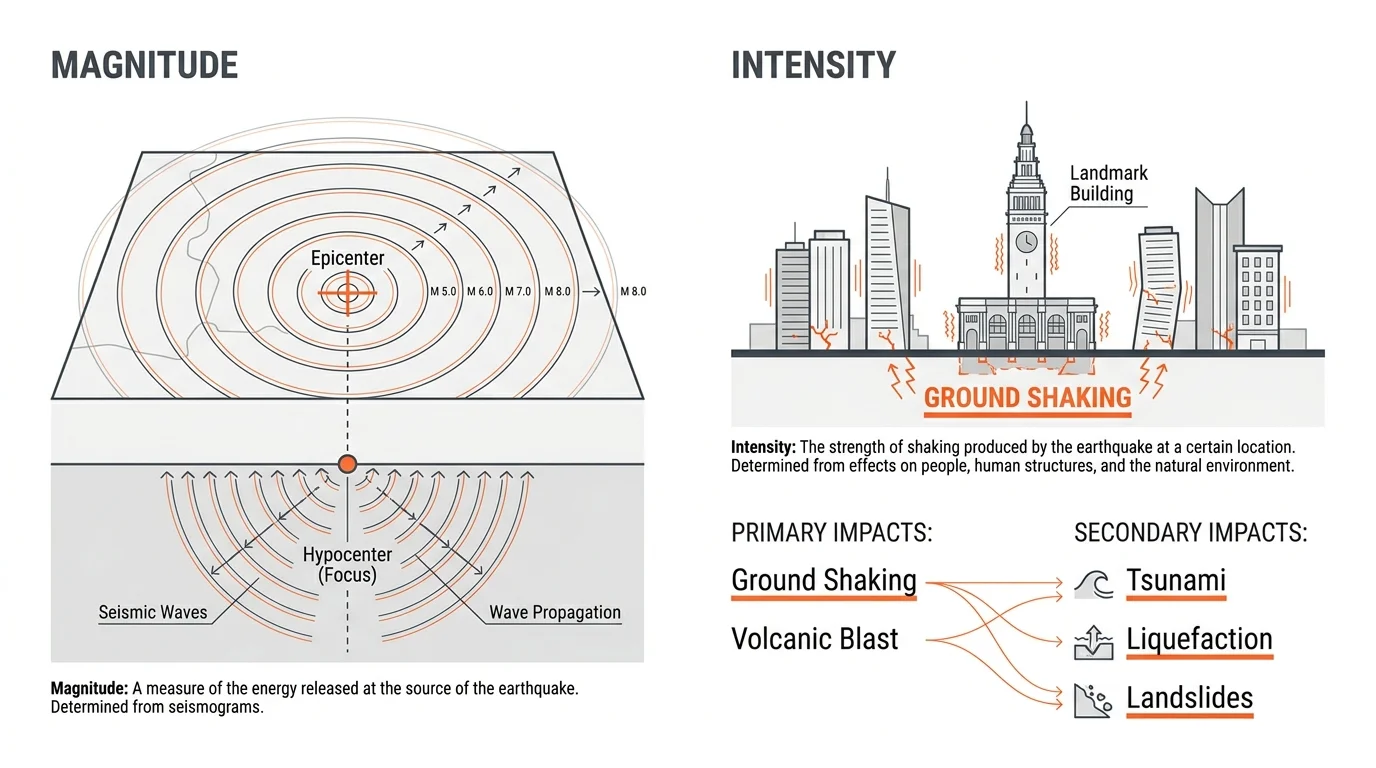
The total destruction or transformation of historic landmarks rarely occurs by random chance; rather, it results from specific geologic mechanisms interacting with structural vulnerabilities. Seismology, the study of earthquakes and the propagation of elastic waves through the Earth, explains many of these events. Most tectonic earthquakes occur along plate boundaries where immense friction temporarily locks massive slabs of the Earth’s crust together. When the accumulated stress exceeds the friction, the plates violently slip, releasing waves of seismic energy. Volcanology focuses on the behavior of magma and the explosive release of dissolved gases, while hydrology and coastal sciences explain the mechanics of tsunamis and storm surges—the abnormal rises in water levels generated by powerful storms or subsea tectonic shifts.
You can see these scientific principles perfectly illustrated in the collapse of the Dharahara Tower during the 2015 Gorkha earthquake in Nepal. To understand this mechanism, structural engineers perform mathematical analyses of seismic resonance. During the magnitude 7.8 mainshock, the fault slip generated low-frequency seismic waves that traveled through the Kathmandu Valley. The deep, soft sediment of the valley basin naturally amplified these low-frequency waves, generally ranging between 0.5 and 2.0 Hertz. This specific frequency precisely matched the natural resonant frequency of the tall, 200-foot Dharahara Tower. The synchronized vibration dramatically amplified the building’s sway. The unreinforced masonry structure experienced peak ground accelerations of 0.16g, which completely overwhelmed the limited shear capacity of the historical brick and mortar. The structural integrity failed instantly, pancaking the landmark into a mound of rubble.
Other landmarks fell victim to radically different mechanisms. In 1692, the bustling colonial port of Port Royal, Jamaica, succumbed to soil liquefaction. When violent earthquake waves pass through loose, water-saturated sandy soils, the intense shaking rapidly increases the water pressure between the individual soil particles. The ground temporarily loses its shear strength and behaves like a heavy liquid. Buildings, streets, and entire forts essentially lose their foundation support and sink directly into the earth. At Port Royal, liquefaction caused nearly thirty-three acres of the town to simply slide into the Caribbean Sea within minutes.
Volcanic mechanisms drove the permanent changes at Pompeii and Mount St. Helens. Vesuvius destroyed Pompeii not through flowing lava, but via pyroclastic density currents—superheated avalanches of toxic gas, ash, and pumice that travel down the slopes of a volcano at hurricane speeds, instantly destroying and burying everything in their path. Conversely, Mount St. Helens experienced a catastrophic lateral blast. A massive landslide suddenly removed the rock containing the highly pressurized magma chamber, causing the mountain to literally explode sideways, forever altering its iconic conical shape and surrounding forest ecosystem.