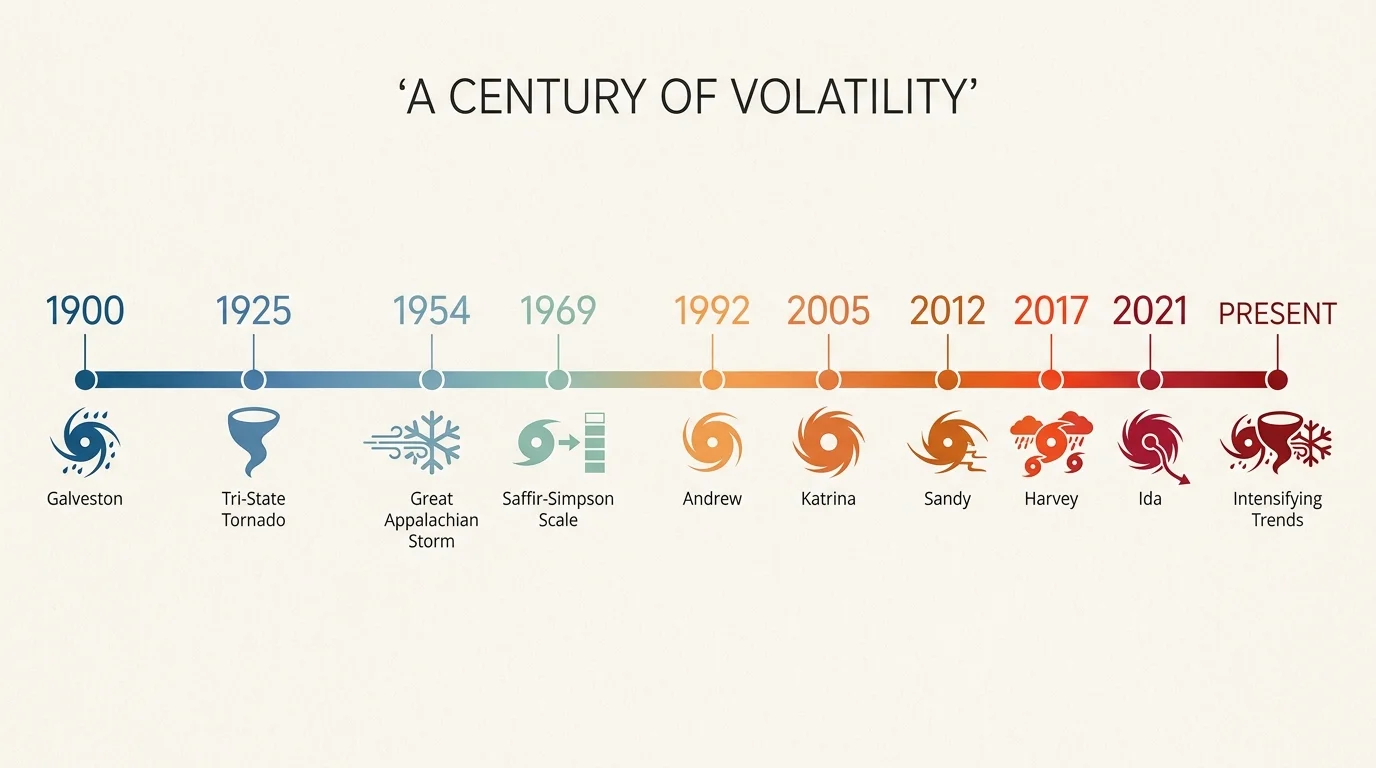
Timeline of 10 Historic Storms
Tracing the timeline of these monumental events reveals a clear pattern of continuous adaptation. The following ten storms stand out not just for their ferocity, but for the permanent changes they forced upon the American landscape and economy.
The Galveston Hurricane (September 8, 1900) remains the deadliest natural disaster in United States history. Striking the booming economic port of Galveston, Texas, this un-named Category 4 hurricane caught residents completely off guard. The U.S. Weather Bureau ignored warnings from Cuban meteorologists, leading to a catastrophic failure in public alerting. A storm surge of 15 feet washed over the island, which had a maximum elevation of just under 9 feet. The storm claimed an estimated 8,000 to 12,000 lives and physically erased millions of dollars in commercial infrastructure, effectively shifting the economic dominance of the Texas coast from Galveston to inland Houston.
The Tri-State Tornado (March 18, 1925) carved a continuous 219-mile path of destruction across Missouri, Illinois, and Indiana. Moving at a staggering forward speed of up to 73 miles per hour, this tornado left towns looking like heavily bombed war zones. Because the word “tornado” was largely banned from weather forecasts at the time to prevent panic, citizens received zero warning. The event killed 695 people and decimated agricultural and mining economies across the three states, eventually forcing the federal government to reconsider its stance on public severe weather warnings.
The Great Okeechobee Hurricane (September 16, 1928) devastated the agricultural heart of Florida. While the storm struck Palm Beach with Category 4 winds, the true catastrophe unfolded inland at Lake Okeechobee. The storm’s winds pushed the shallow lake waters southward, overtopping and obliterating the fragile earthen mud dike protecting local farming communities. Over 2,500 people drowned, the majority of whom were migrant agricultural workers. The economic loss of the region’s farming infrastructure forced the federal government to directly intervene in inland flood control engineering.
The Labor Day Hurricane (September 2, 1935) slammed into the Florida Keys as the first known Category 5 hurricane to make landfall in the contiguous United States. It recorded a barometric pressure of 892 millibars, an indicator of extreme atmospheric intensity. The storm generated a localized surge that completely swept away a train sent to evacuate World War I veterans working on a highway project. The destruction of Henry Flagler’s Florida East Coast Railway over the ocean permanently changed the transportation economics of the Keys, forcing the transition from rail to the modern highway system you use today.
Hurricane Camille (August 17, 1969) struck the Mississippi Gulf Coast with winds estimated at 175 miles per hour. The winds blew so fiercely that they destroyed the weather instruments designed to measure them. Camille flattened commercial shipping infrastructure and leveled coastal neighborhoods. The sheer unpredictability of Camille’s extreme winds highlighted a severe flaw in how meteorologists communicated risk to the public, directly catalyzing the engineering and adoption of the Saffir-Simpson Hurricane Wind Scale to help you better understand storm threats.
The Super Outbreak (April 3-4, 1974) fundamentally changed tornado science. Over just 16 hours, 148 tornadoes touched down across 13 states, causing more than $843 million in damage. This massive meteorological anomaly overwhelmed the existing radar and warning networks. The sheer scale of the US disaster impact prompted the National Weather Service to completely overhaul its early warning systems, invest heavily in Doppler radar technology, and support Dr. Ted Fujita’s rigorous scientific mapping of tornado tracks and wind dynamics.
Hurricane Andrew (August 24, 1992) reshaped the economic reality of property insurance. Striking south of Miami as a compact but ferociously intense Category 5 hurricane, Andrew caused $27.3 billion in damage. It ripped apart thousands of newly built homes, exposing shockingly lax building code enforcement and cheap construction materials during Florida’s 1980s housing boom. Several major insurance companies went totally bankrupt trying to pay out claims, forcing the state to invent new economic safety nets and strictly regulate how developers build residential properties.
Hurricane Katrina (August 29, 2005) delivered the most complex engineering and administrative failure in modern American history. While Katrina weakened to a Category 3 before hitting Louisiana and Mississippi, its massive physical magnitude pushed a catastrophic surge into the Gulf Coast. The root cause analysis later revealed that the U.S. Army Corps of Engineers’ levee system protecting New Orleans failed due to foundational design flaws, not just the storm’s power. Over 1,800 people died, and the disaster inflicted roughly $125 billion in economic damage, exposing deeply rooted inequalities and triggering a total reconstruction of federal emergency response policies.
Superstorm Sandy (October 29, 2012) demonstrated the acute vulnerability of legacy infrastructure in the Northeast. Sandy underwent an extratropical transition, merging with a winter frontal system to create a hybrid storm of unprecedented size. Though technically no longer a hurricane at landfall, Sandy drove a massive surge directly into New York and New Jersey. The saltwater flooded subway tunnels, disabled Wall Street data centers, and destroyed billions of dollars in coastal property. Sandy forced engineers to recognize that sea-level rise turns historically manageable storms into existential economic threats.
Hurricane Harvey (August 25, 2017) rewrote the textbooks on pluvial flooding—flooding caused by extreme rainfall. Caught between two high-pressure ridges, Harvey stalled over southeastern Texas and dropped an astonishing 60 inches of rain over several days. The storm caused $125 billion in damage, matching Katrina. Harvey proved that you do not need to live on the immediate coast or in a designated flood zone to lose everything. It highlighted the catastrophic economic consequences of rapid, unregulated urban sprawl paving over natural drainage basins.