Timeline
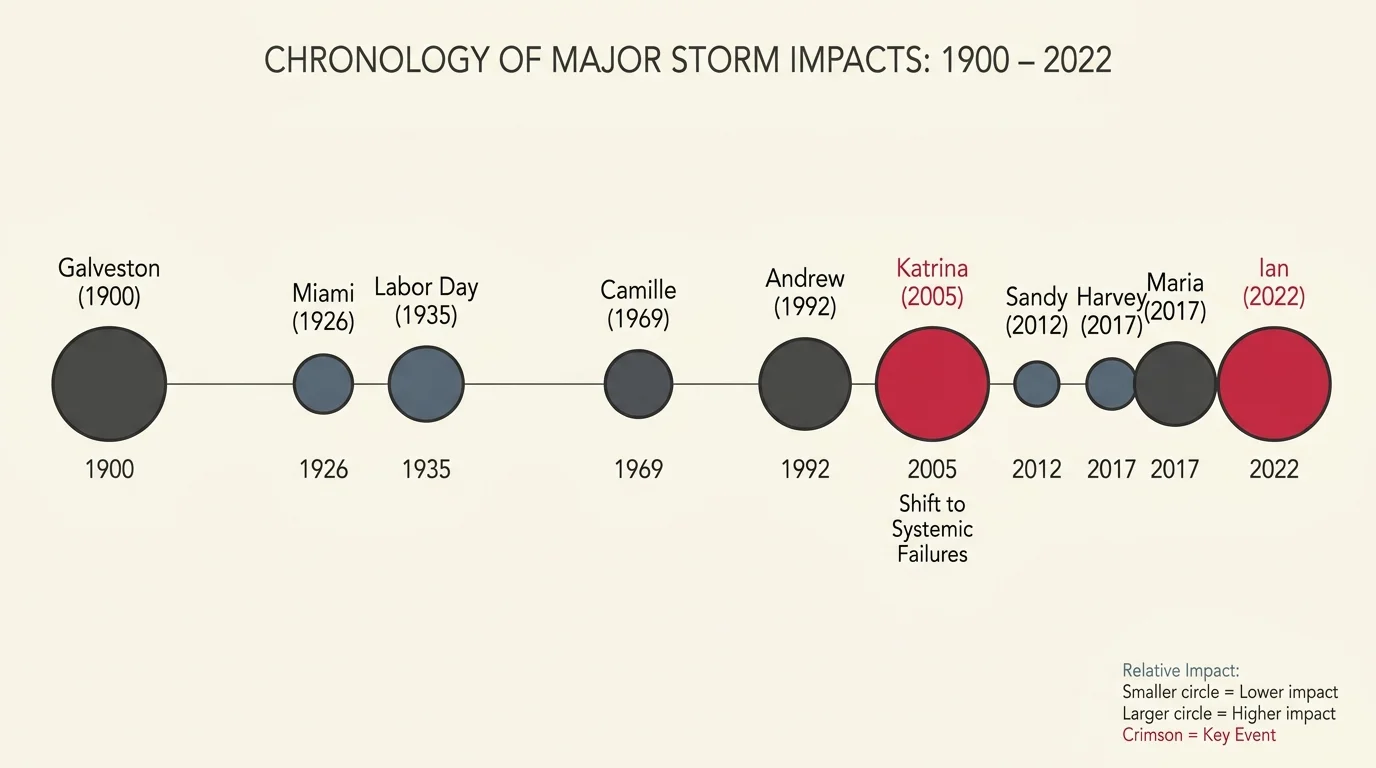
The timeline of these ten transformative hurricanes tracks perfectly with the evolution of America’s hazard awareness and technological capabilities. In the opening days of the twentieth century, warning systems were dangerously rudimentary. On September 8, 1900, the Galveston Hurricane struck the booming Texas island city with practically no advanced warning. Local forecasters relied on delayed ship reports and telegraphic communications, missing the storm’s true intensity. The surprise arrival of a 15-foot surge over an island with a maximum elevation of less than nine feet resulted in the highest single-event death toll in United States history.
Twenty-six years later, the Great Miami Hurricane of 1926 demonstrated the perils of rapid demographic shifts. Florida was in the midst of a massive real estate boom, drawing thousands of new residents who possessed zero experience with tropical cyclones. When the hurricane made landfall in September, it breached poorly constructed developments. Tragically, when the eye of the storm passed over the city, countless residents assumed the weather event was over and walked outside, only to be caught completely exposed when the powerful backside of the eyewall struck.
The Labor Day Hurricane of 1935 struck the Florida Keys as the most intense landfalling hurricane on record, featuring a terrifyingly low pressure of 892 millibars. The timeline of this disaster is defined by communication breakdowns and logistical failures. Officials attempted to dispatch a rescue train to evacuate World War I veterans working on a highway project, but the train was delayed and ultimately swept off the tracks by the storm surge, highlighting the lethal consequences of delayed decision-making.
By the mid-twentieth century, technology began to shift the timeline from reaction to anticipation. When Hurricane Camille slammed into the Gulf Coast in 1969, forecasters had access to satellite imagery and radar. However, public communication remained flawed. Warnings were issued, but many residents lacked a clear understanding of what a Category 5 storm surge actually meant. Camille’s devastating impact directly motivated meteorologists to develop clearer communication tools, ultimately resulting in the widespread adoption of the Saffir-Simpson scale to help you understand your immediate wind risk.
The late twentieth century introduced a new era of engineering scrutiny. In August 1992, Hurricane Andrew tore through South Florida. The timeline of Andrew’s impact was terrifyingly brief—it crossed the state in just a few hours—but its legacy spans decades. Andrew exposed systemic fraud and negligence in the construction industry, proving that warning time means nothing if your home is structurally compromised from the day it is built.
The twenty-first century has been defined by complex, multi-layered catastrophes. The timeline of Hurricane Katrina in August 2005 is a grim study in cascading failures. The initial landfall on the Gulf Coast caused catastrophic wind and surge damage, but the true historical pivot occurred over the subsequent 48 hours as the levee system in New Orleans progressively failed, filling the geographic bowl of the city with water and stranding tens of thousands of citizens.
Following Katrina, the timelines of Hurricane Sandy in 2012 and Hurricane Harvey in 2017 showcased the vulnerability of massive urban centers. Sandy’s agonizingly slow approach up the Eastern Seaboard allowed for days of preparation, yet the sheer size of the storm pushed a massive surge into the unprepared subway tunnels and electrical substations of New York City. Harvey’s timeline in 2017 was marked by a days-long stationary deluge, stretching the endurance of civilian rescue fleets and first responders to their absolute limits.
Also in 2017, Hurricane Maria devastated Puerto Rico. The timeline here extends far beyond the September landfall. The true catastrophe unfolded over the following eleven months, as the total collapse of the island’s power grid created a prolonged humanitarian crisis. Finally, the rapid escalation of Hurricane Ian in 2022 compressed the warning timeline severely, forcing a reckoning with how we model, communicate, and react to storms that explode in intensity just hours before landfall.