Causes & Mechanisms
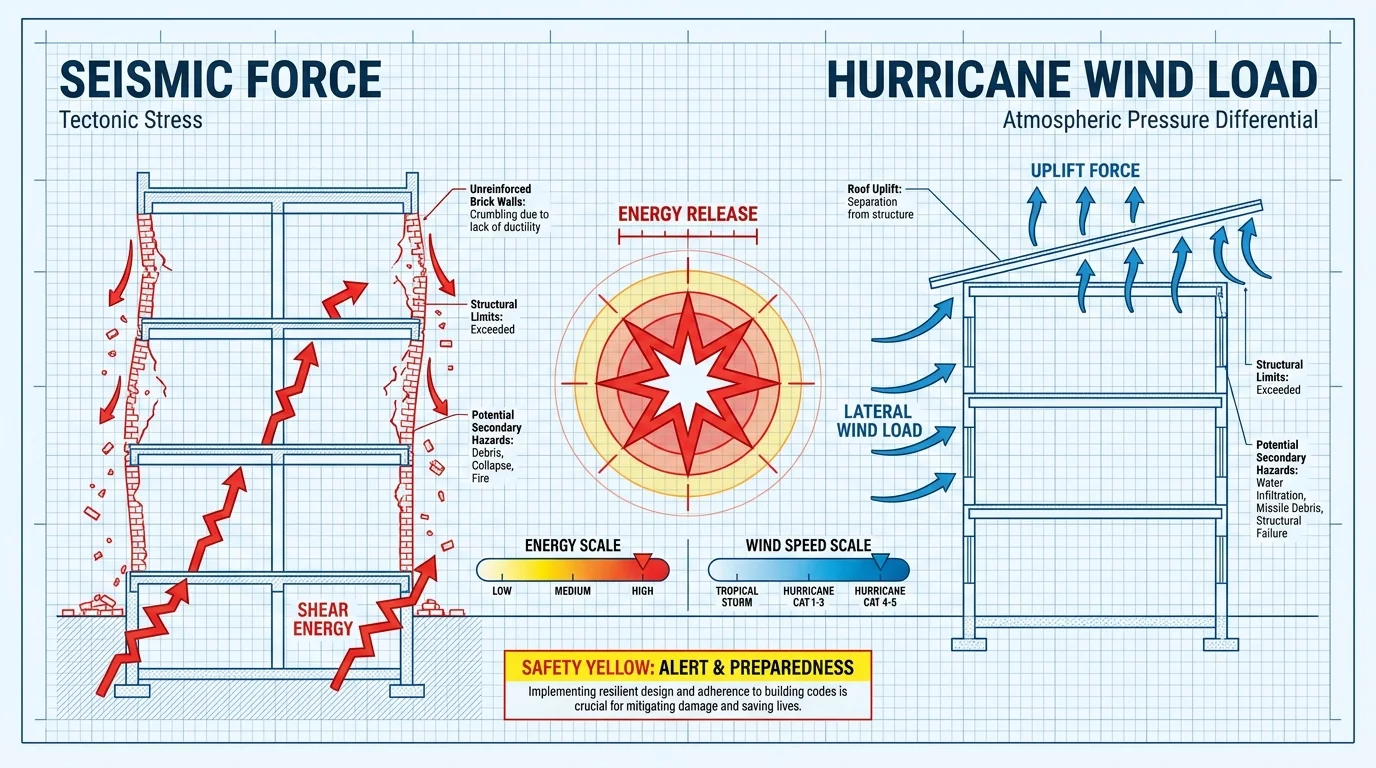
To understand why these eight disasters proved so destructive, you must first understand the specific hazard science and physical mechanisms driving them. Natural hazards operate on massive scales, releasing unimaginable amounts of energy that test the ultimate limits of human engineering. The specific forces involved dictate exactly how infrastructure fails and what types of secondary hazards emerge after the initial event.
Seismology explains the violent ground motions that defined the San Francisco, Long Beach, and Loma Prieta earthquakes. When measuring these events, scientists differentiate between magnitude and intensity. Magnitude measures the total energy released at the earthquake source, while intensity describes the severity of shaking at a specific geographic location. During the 1989 Loma Prieta earthquake, the geologic phenomenon of liquefaction caused catastrophic damage. Liquefaction occurs when intense shaking forces water-saturated, unconsolidated soil to temporarily lose its structural strength and behave like a thick fluid. When the soil beneath the Marina District liquefied, the foundations of large apartment buildings simply sank, causing the structures above to warp and collapse.
Meteorology governs the lethal forces unleashed by the Galveston Hurricane, Hurricane Camille, Hurricane Andrew, and Hurricane Katrina. The defining destructive mechanism for coastal communities is storm surge. A storm surge is a rapid, abnormal rise in coastal water levels caused primarily by a storm’s fierce winds pushing ocean water onto the shore, compounded by a severe drop in atmospheric pressure. Furthermore, intense wind loading creates powerful aerodynamic forces that attack the structural integrity of buildings. When winds exceed specific velocities, they generate an upward lift that can violently detach roofs from walls if the connections lack sufficient reinforcing hardware.
To fully grasp how these forces overwhelm built environments, consider a precise, worked mini-example of the mechanisms at play during Hurricane Katrina. When Katrina approached the Gulf Coast, it pushed a colossal dome of ocean water ahead of its path. Making landfall as a large Category 3 hurricane, Katrina generated a localized storm surge exceeding 28 feet along the Mississippi coast. This massive wall of water exerted extreme hydrodynamic pressure on levee systems engineered for significantly lower thresholds. The physical weight of the storm surge simply snapped concrete floodwalls and scoured away the protective earthen foundations underneath them. This mechanism vividly demonstrates exactly how a failure to accurately calculate extreme environmental stress leads to immediate catastrophic collapse.
Hydrology reveals the mechanisms behind the 1927 Great Mississippi Flood. A river basin operates as a massive drainage system for an entire continent. When months of unseasonably heavy rainfall saturated the vast watershed of the central United States, the soil lost its capacity to absorb additional moisture. The excess water flowed directly into tributaries, ultimately overwhelming the main channel of the Mississippi River. The sheer volume and velocity of the water increased the hydrostatic pressure against earthen levees until the structures reached their breaking points, causing massive crevasses that flooded millions of acres of farmland.