Causes & Mechanisms
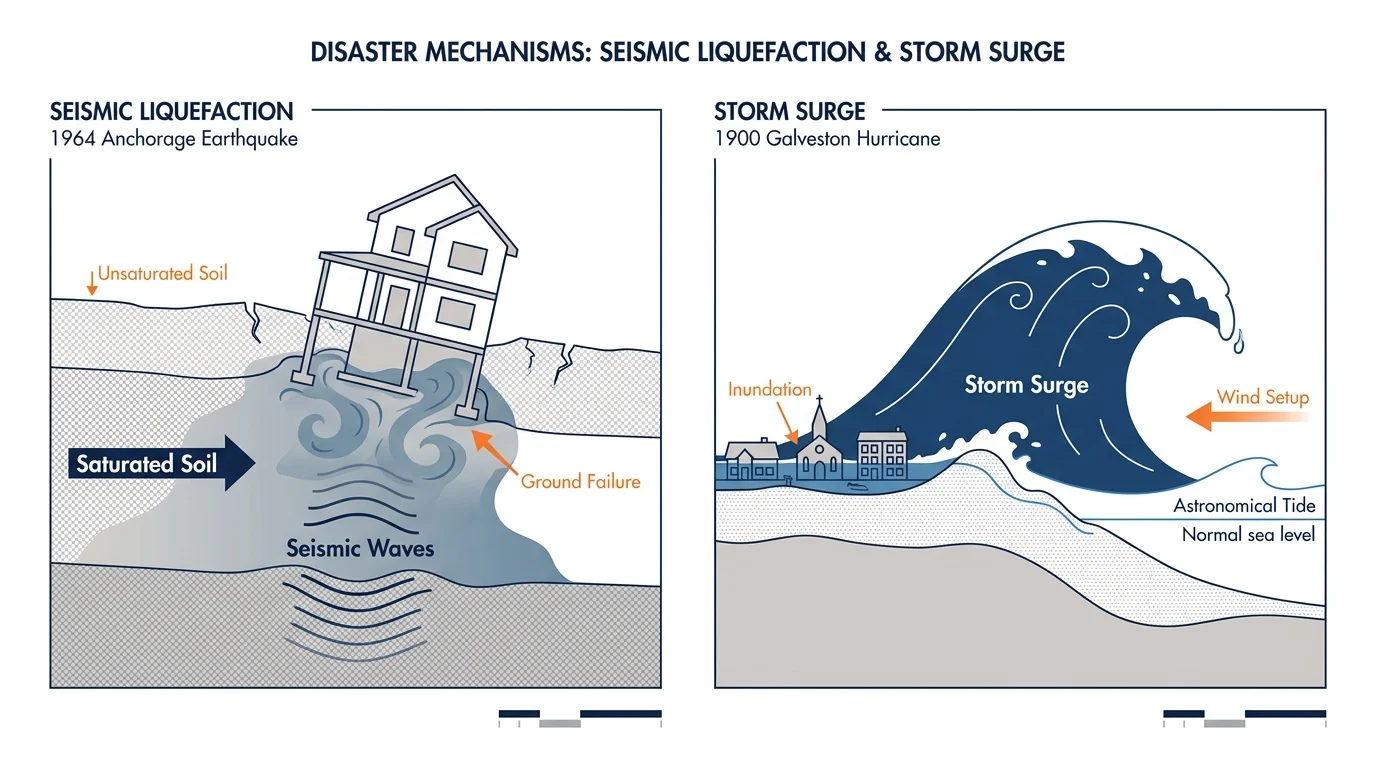
Understanding the destruction of these eight cities requires a solid grasp of the underlying hazard science. Disasters occur when extreme natural forces intersect with vulnerable human environments. In seismology, scientists differentiate between magnitude and intensity. Magnitude measures the total energy released at an earthquake’s source, while intensity quantifies the observed shaking at a specific location. During the 1906 San Francisco earthquake and the 1964 Anchorage earthquake, extreme intensity caused catastrophic ground failure. In Anchorage, a subduction zone megathrust earthquake—the most powerful type of seismic event—triggered widespread liquefaction. Liquefaction occurs when saturated soil loses its strength and acts like a liquid, causing heavy structures to sink or collapse entirely.
Meteorological hazards devastated other cities on this list. When analyzing hurricanes, atmospheric scientists focus on storm surge. Storm surge represents the abnormal rise in seawater level generated by a storm, measured as the height of the water above the normal predicted astronomical tide. The 1900 Galveston hurricane pushed a massive surge over a low-lying barrier island, completely inundating the city. Similarly, Hurricane Katrina in 2005 generated a storm surge that overwhelmed the levee systems surrounding New Orleans, creating catastrophic secondary impacts as floodwaters filled the city’s geographical bowl. In Homestead, Hurricane Andrew produced extreme wind velocities that exploited the structural weaknesses of residential homes, tearing roofs from walls and demonstrating the destructive potential of compact, intense atmospheric pressure systems.
In Greensburg, Kansas, the destructive mechanism was a massive EF5 tornado. The Enhanced Fujita scale classifies tornadoes based on estimated wind speeds and related damage. An EF5 tornado produces winds exceeding 200 miles per hour, generating immense pressure differentials that can pull well-anchored homes directly from their foundations. The meteorological setup for such a storm requires highly unstable air, significant wind shear, and a strong triggering mechanism, all of which converged over Greensburg in May 2007.
Hydrological and engineering failures represent another category of total destruction. You can evaluate the 1889 Johnstown flood through the lens of root cause analysis—a methodical process used to identify the fundamental reasons why a system failed. The South Fork Dam failed due to poor maintenance, inadequate spillway capacity, and unauthorized structural modifications by private owners. When intense rainfall filled the reservoir, the earth-fill dam overtopped and collapsed, sending a massive wall of water down a narrow valley. Meanwhile, the 1871 Great Chicago Fire highlighted the dangers of urban conflagrations. The primary impacts of prolonged drought and high winds combined with a city built almost entirely of wood, allowing the fire to create its own localized weather system and leap across natural barriers like the Chicago River.