
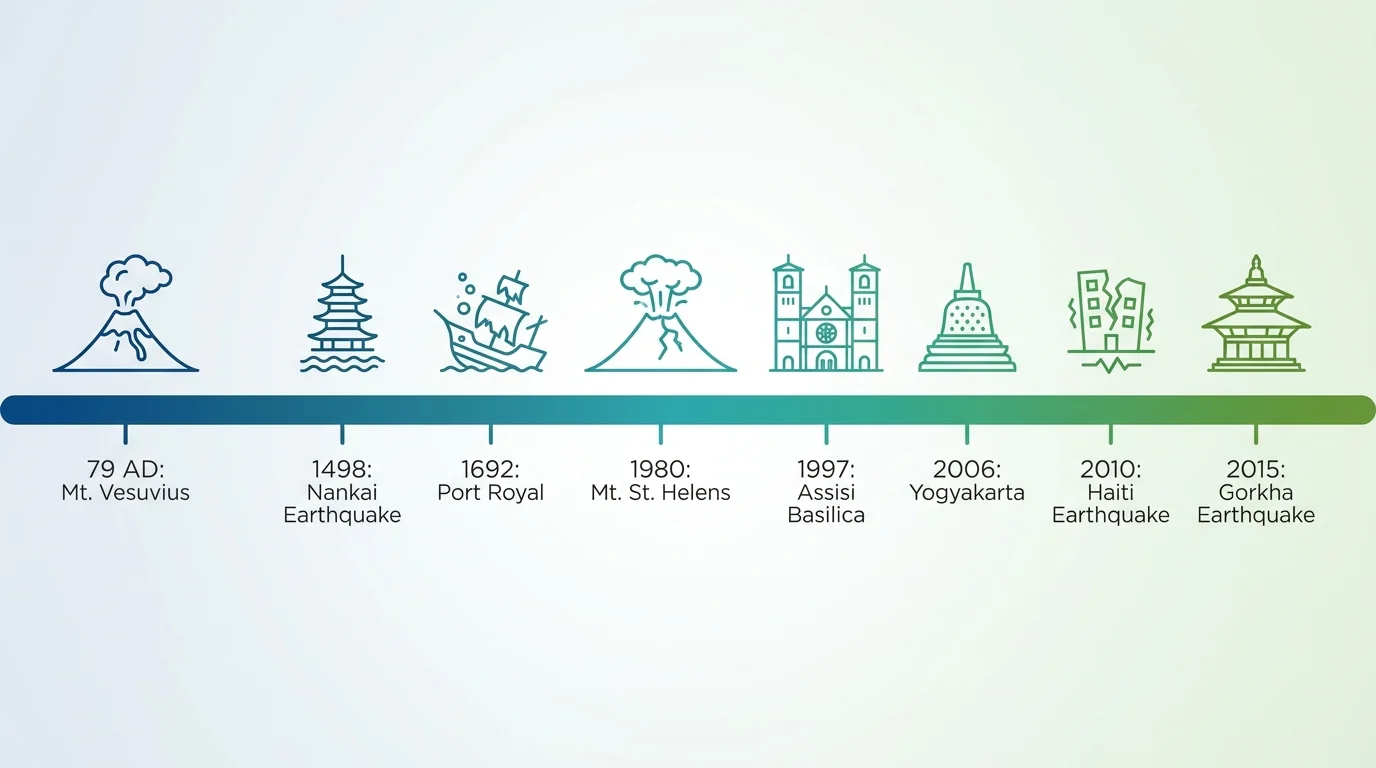
Timeline
Tracing the chronology of these eight disasters reveals how the speed and suddenness of natural forces catch communities completely off guard. In the ancient world, the destruction of Pompeii by Mount Vesuvius unfolded over two terrifying days. Historical accounts date the eruption to either August 24 or late October in the year 79 AD. The volcano first sent a massive column of ash and pumice 20 miles into the stratosphere. Over the next 18 hours, this material rained down heavily on the city. The fatal blow arrived the following morning when a series of scorching pyroclastic surges swept through the streets, instantly killing the remaining population and burying the bustling Roman landmark under 20 feet of volcanic debris for centuries.
Centuries later, on September 20, 1498, a massive subduction zone earthquake struck the Nankai trough off the coast of Japan. The resulting tsunami funneled directly into the coastal city of Kamakura. At the time, the Great Buddha—a massive 93-ton bronze statue—sat safely enclosed inside a massive wooden temple hall. The wall of water surged inland, violently tearing the immense wooden structure from its stone foundations and washing it out to sea. The disaster permanently left the Great Buddha sitting directly under the open sky, an iconic image that persists today.
The Age of Exploration saw its own catastrophic loss on June 7, 1692. Just before noon, a massive earthquake struck the island of Jamaica. Within two minutes, three massive shocks rocked the infamous pirate haven of Port Royal. The immediate soil liquefaction caused entire streets to vanish under the water. Shortly after the shaking stopped, a localized tsunami swept over the sinking town, drowning the remaining masonry structures and permanently moving the economic hub of the island to Kingston.
In the modern era, precise instrumentation gives us exact timestamps of sudden transformations. On May 18, 1980, at exactly 8:32 a.m. Pacific Daylight Time, a magnitude 5.1 earthquake triggered the largest landslide in recorded history on the north face of Mount St. Helens. Seconds later, the depressurized magma exploded outward, obliterating the top 1,300 feet of the mountain. Seventeen years later, on September 26, 1997, two powerful earthquakes struck the Umbria region of Italy. The second shock, occurring at 11:40 a.m. local time, severely fractured the vaulted ceilings of the Basilica of St. Francis of Assisi, sending priceless medieval frescoes crashing to the floor.
The twenty-first century has witnessed rapid, successive destruction of cultural heritage. On May 27, 2006, at 5:54 a.m., a violent magnitude 6.4 earthquake struck the Special Region of Yogyakarta in Indonesia, heavily fracturing the towering stone spires of the 9th-century Prambanan Temple Complex. On January 12, 2010, at 4:53 p.m. local time, a shallow, devastating magnitude 7.0 earthquake struck directly under Port-au-Prince, Haiti. Within thirty seconds, the massive white domes of the National Palace pancaked into the building’s footprint. Just five years later, on April 25, 2015, at 11:56 a.m. Nepal Standard Time, the magnitude 7.8 Gorkha earthquake shattered the historic center of Kathmandu, completely destroying the Dharahara Tower while visitors were actively climbing its interior spiral staircase.