Lessons Learned and the Evolution of Automotive Safety
While tragic, these high-profile car crashes have served as crucial turning points in the history of automotive safety, accelerating both regulatory reform and public awareness. They provide clear, understandable examples of risks that safety engineers had been working to solve, and the public outcry often provided the political will to implement changes.
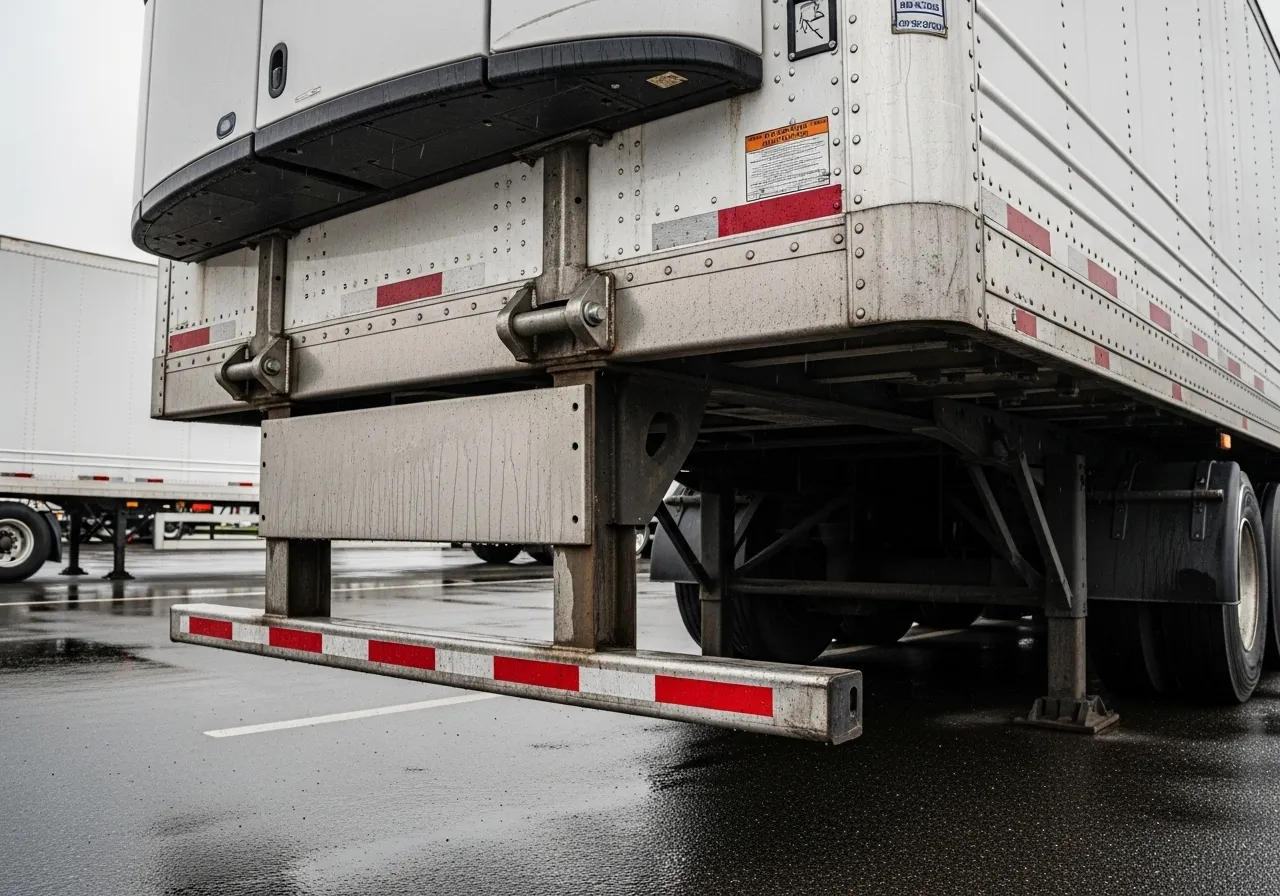
One of the clearest examples of this is the “Mansfield bar.”
Worked Example: The Mansfield Bar. Before the 1967 crash involving Jayne Mansfield, underride collisions were a known but not widely publicized danger. Her death made the problem impossible to ignore. In response, the National Highway Traffic Safety Administration (NHTSA) began a process that led to a federal requirement for strong rear impact guards on most new truck trailers. These guards are engineered to withstand a significant impact and prevent a smaller vehicle’s passenger compartment from sliding under the trailer bed, allowing the car’s own crumple zones and safety systems to absorb the energy of the crash as designed.
The importance of seatbelts is another recurring lesson. In 1997, the stark difference in outcome between the belted bodyguard and the unbelted occupants in Princess Diana’s car provided an undeniable, real-world demonstration of their effectiveness. The fact that the most protected person in the vehicle was the only one to survive sent a powerful message. This, combined with decades of data and public service campaigns, has helped drive seatbelt usage rates in the United States from around 11% in the early 1980s to over 90% today.
The evolution of vehicle stability technology is another key lesson.
Worked Example: Electronic Stability Control (ESC). The 2005 Porsche Carrera GT involved in Paul Walker’s death was an analog supercar built without modern computer-aided stability systems. ESC, which became mandatory for all U.S. passenger vehicles in the 2012 model year, uses a series of sensors to detect when a driver is about to lose control. If it detects a skid or a spin, it can automatically and instantaneously apply the brakes to individual wheels to help steer the vehicle back on its intended path. The NHTSA estimates that ESC reduces single-vehicle car crash fatalities by over 30% and single-vehicle SUV crash fatalities by over 50%. It is highly probable that if a car like the Carrera GT had been equipped with ESC, the initial loss of control at high speed could have been prevented.
Finally, the cases of Ryan Dunn and Henri Paul serve as brutal reminders of the ongoing fight against impaired driving. These events reinforce the message promoted for decades by organizations like Mothers Against Drunk Driving (MADD): alcohol and driving create a fatal combination. They provide high-profile examples that are used in awareness campaigns to illustrate that the laws of physics are indifferent to fame or fortune.
Emergency guidance at the FEMA and hazard science at the USGS and NOAA/NWS.
Transport and workplace investigations via the NTSB and OSHA. Risk reduction resources at the UNDRR.