
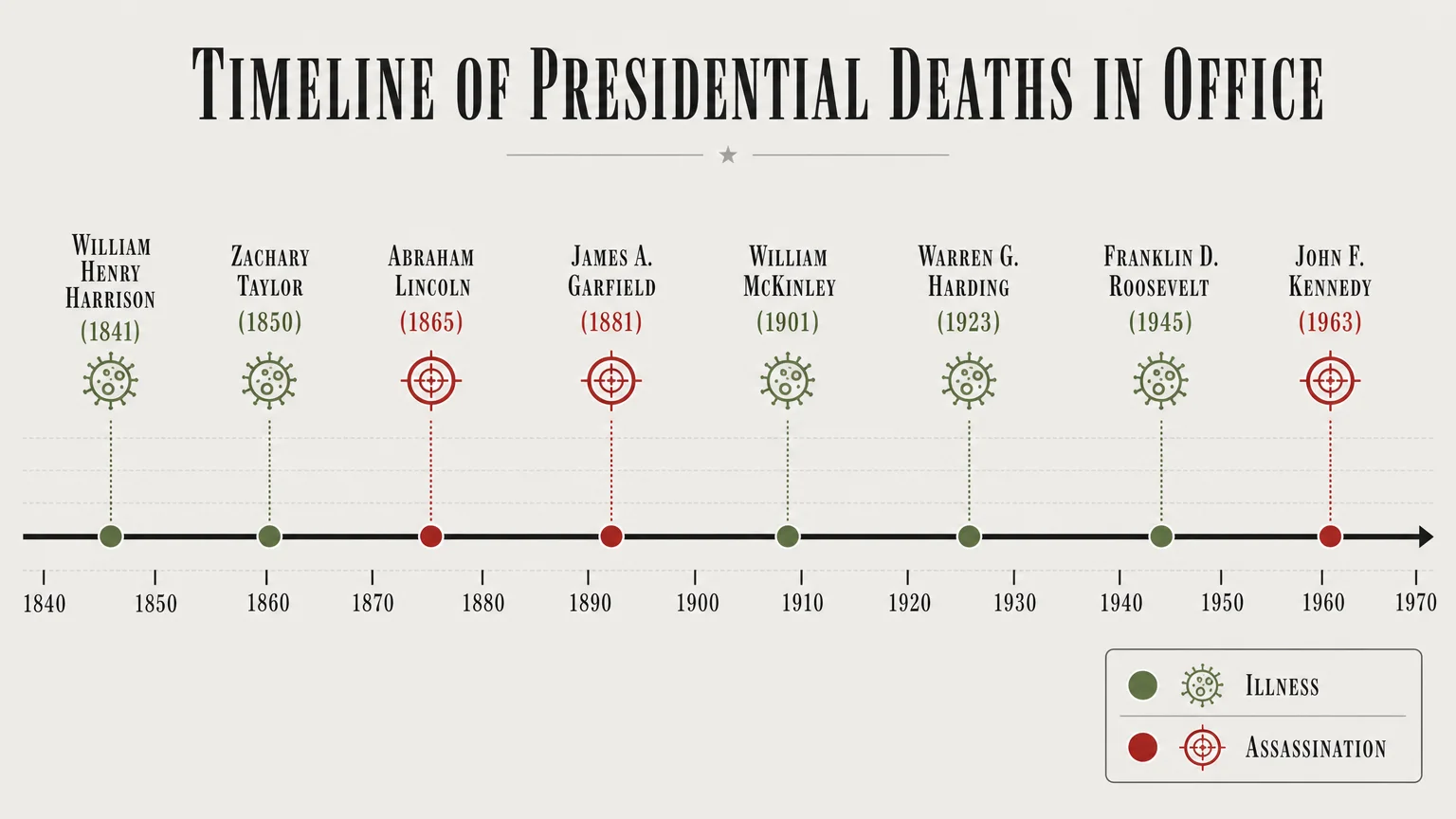
Timeline
The sequence of fatal presidential crises began in the spring of 1841. William Henry Harrison delivered a notoriously lengthy inaugural address in freezing weather on March 4. Weeks later, he developed severe gastrointestinal distress and a high fever. His condition rapidly deteriorated as doctors applied archaic treatments, including bleeding and blistering. On April 4, 1841, just thirty-one days into his administration, Harrison died. This unprecedented event triggered immediate confusion over whether Vice President John Tyler simply acted as an interim caretaker or assumed the full office. Tyler decisively took the presidential oath, establishing the vital continuity precedent.
Nine years later, the executive branch faced another sudden vacuum. On July 4, 1850, Zachary Taylor attended a fundraising celebration at the Washington Monument under intense summer heat. After consuming iced water and fruit, he developed severe cramping and acute gastroenteritis. Over the next five days, Taylor suffered intense dehydration and systemic shock. He died on the evening of July 9, 1850. Vice President Millard Fillmore immediately assumed office, abruptly shifting the administration’s political stance on the expansion of slavery and paving the way for the Compromise of 1850.
The trajectory of American history violently fractured on the evening of April 14, 1865. President Abraham Lincoln sat inside a relatively unguarded box at Ford’s Theatre in Washington, D.C. At approximately 10:15 PM, John Wilkes Booth infiltrated the box and fired a single derringer pistol shot into the back of Lincoln’s head. Responders immediately carried the unconscious president across the street to the Petersen House. Despite the desperate efforts of Army surgeons to relieve cranial pressure, Lincoln officially expired at 7:22 AM on April 15, 1865. His death profoundly derailed post-Civil War Reconstruction efforts.
The timeline of tragedy resumed on July 2, 1881. President James A. Garfield walked through the Baltimore and Potomac Railroad Station in Washington, D.C., entirely lacking a dedicated security detail. Disgruntled office seeker Charles J. Guiteau approached Garfield from behind and fired two shots from a revolver. Over the next seventy-nine days, the nation watched in suspense as Garfield lingered in intense agony. Doctors relocated him to a specialized cottage in Elberon, New Jersey, hoping the coastal air would aid recovery. The massive infection finally overtook his weakened system, and Garfield died on September 19, 1881.
The dawn of the twentieth century brought the third presidential assassination. On September 6, 1901, President William McKinley stood in a receiving line at the Pan-American Exposition in Buffalo, New York. Leon Czolgosz approached the president with a revolver concealed inside a wrapped handkerchief. Czolgosz fired twice at point-blank range, striking McKinley in the abdomen. Surgeons rushed to operate under poor lighting conditions, closing the wound without locating the bullet. Gangrene quietly developed along the internal wound track. McKinley succumbed to the systemic infection eight days later, passing away in the early hours of September 14, 1901.
Two decades later, an illness quietly compromised the presidency while the executive traveled across the country. Throughout the summer of 1923, President Warren G. Harding engaged in an exhausting cross-country “Voyage of Understanding.” While in Seattle, he suffered severe abdominal pain and shortness of breath, symptoms doctors initially misdiagnosed as food poisoning. His train rushed south to San Francisco, where his condition seemingly stabilized. However, on the evening of August 2, 1923, Harding collapsed in his hotel suite and died instantly. Modern medical analysts conclude he suffered a massive myocardial infarction, commonly known as a heart attack.
The global crisis of World War II compounded the next executive loss. On April 12, 1945, President Franklin D. Roosevelt sat for a portrait at his retreat in Warm Springs, Georgia. At 1:00 PM, he suddenly complained of a terrific pain in the back of his head and slumped forward unconscious. The attending cardiologist quickly recognized the symptoms of a massive cerebral hemorrhage. Despite the deployment of emergency medical procedures, Roosevelt died at 3:35 PM. Vice President Harry S. Truman took the oath of office just hours later, immediately assuming the immense burden of concluding the global conflict.
The final and arguably most extensively analyzed death occurred on November 22, 1963. President John F. Kennedy rode through Dealey Plaza in Dallas, Texas, in an open-top limousine. At 12:30 PM Central Standard Time, sniper fire struck the president from the Texas School Book Depository. The motorcade immediately accelerated to Parkland Memorial Hospital, arriving within minutes. Trauma teams initiated extreme emergency resuscitation protocols, but the massive neurological damage proved irreversible. Doctors pronounced Kennedy dead at 1:00 PM. Vice President Lyndon B. Johnson took the oath of office aboard Air Force One at 2:38 PM, securing the continuity of government before departing for Washington.













1 thought on “8 Presidential Deaths That Changed America”
This was a very well-written and researched article. I thought I knew this information already. I did not. I learned something today. Some of the presidents I’m familiar with, were actually beneficiaries of the 25th Amendment.