Timeline of System Failures
The modern American water crisis did not emerge overnight; it developed through decades of deferred maintenance, evolving industrial practices, and regulatory delays. Tracing the timeline of these systemic failures reveals exactly how contamination events escalate from localized anomalies into national public health emergencies. In 1974, Congress passed the Safe Drinking Water Act, establishing the first comprehensive federal standards for tap water. While this legislation drastically reduced waterborne diseases like cholera and typhoid, it failed to anticipate the explosive growth of synthetic chemicals and the slow decay of underground lead networks.
Throughout the late 1990s and early 2000s, specific communities began exposing critical gaps in regulatory oversight. In 1996, residents of Hinkley, California, secured a massive legal settlement after discovering energy companies had routinely dumped hexavalent chromium into unlined ponds, deeply contaminating their groundwater. Shortly after, in 2001, internal investigations revealed that chemical plants near Parkersburg, West Virginia, had spent decades discharging PFOA—a toxic forever chemical—into local waterways, marking the first major public awareness of the PFAS crisis.
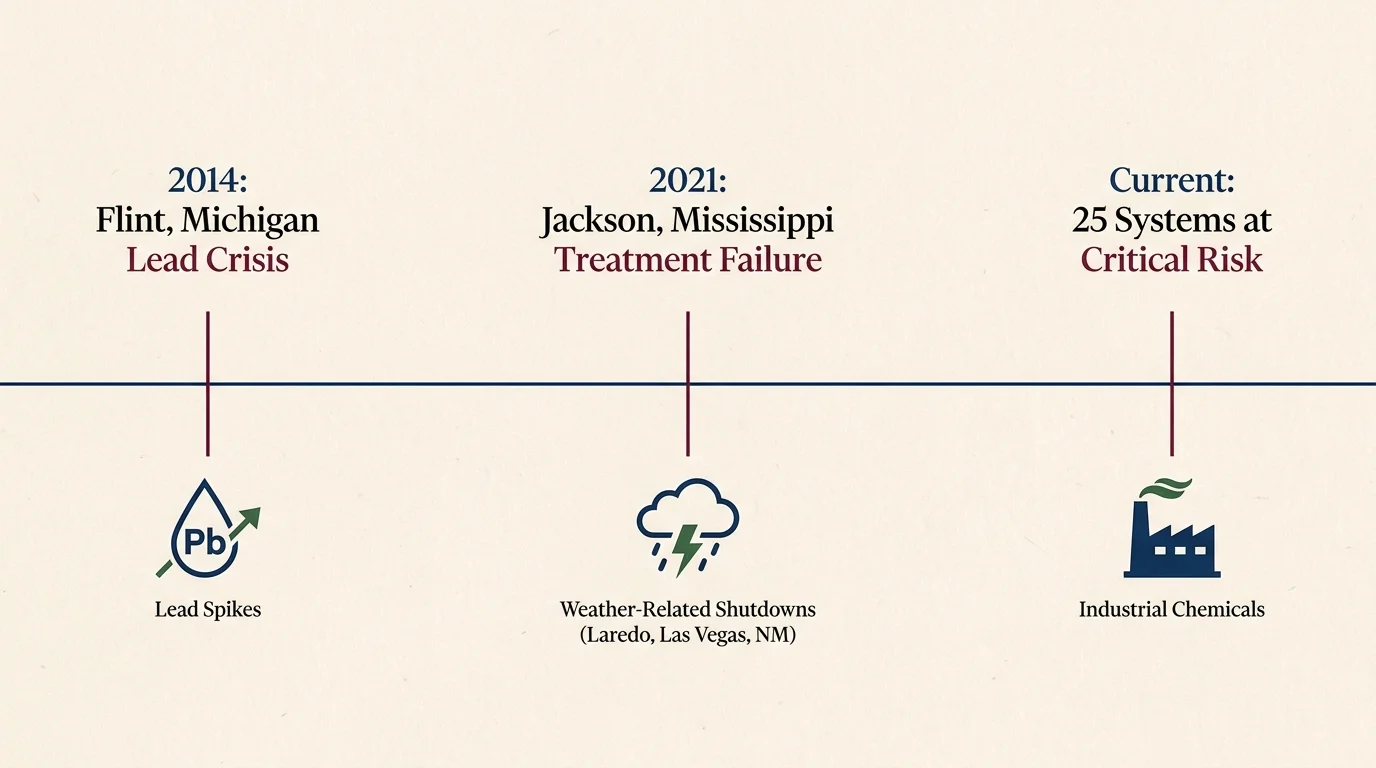
The timeline of catastrophic infrastructure failure accelerated sharply in the 2010s. In April 2014, officials in Flint, Michigan, switched their municipal water source from the Detroit water system to the Flint River as a cost-saving measure. By ignoring established corrosion control protocols, they unleashed massive quantities of lead into the community’s drinking water. It took nearly eighteen months of citizen protests and independent scientific testing before state officials finally admitted the crisis and declared a state of emergency in early 2016. The Flint disaster forced regulators to reevaluate lead infrastructure nationwide, prompting cities like Newark, New Jersey, to audit their own service lines and uncover similarly dangerous lead leaching in 2017.
Extreme weather events introduced a new phase of system failures in the 2020s. In February 2021, severe winter storms triggered massive power grid failures across Texas, causing water pressure in cities like Houston and Laredo to drop to zero, allowing groundwater and bacteria to siphon back into the municipal pipes. In August 2022, torrential rains flooded the Pearl River in Jackson, Mississippi. The floodwaters completely overwhelmed the city’s main water treatment plant, leaving more than 150,000 residents without running water for weeks and exposing decades of systemic neglect.
Regulatory agencies finally began modernizing their approach to these compounded threats in the mid-2020s. In April 2024, the Environmental Protection Agency established the first legally enforceable maximum contaminant levels for six specific PFAS compounds, requiring utilities to monitor and filter these chemicals down to parts per trillion. This mandate represents a historic shift, forcing thousands of water systems nationwide to acknowledge their contamination status and begin the expensive, multi-year process of upgrading their treatment facilities to meet modern safety standards.