Timeline
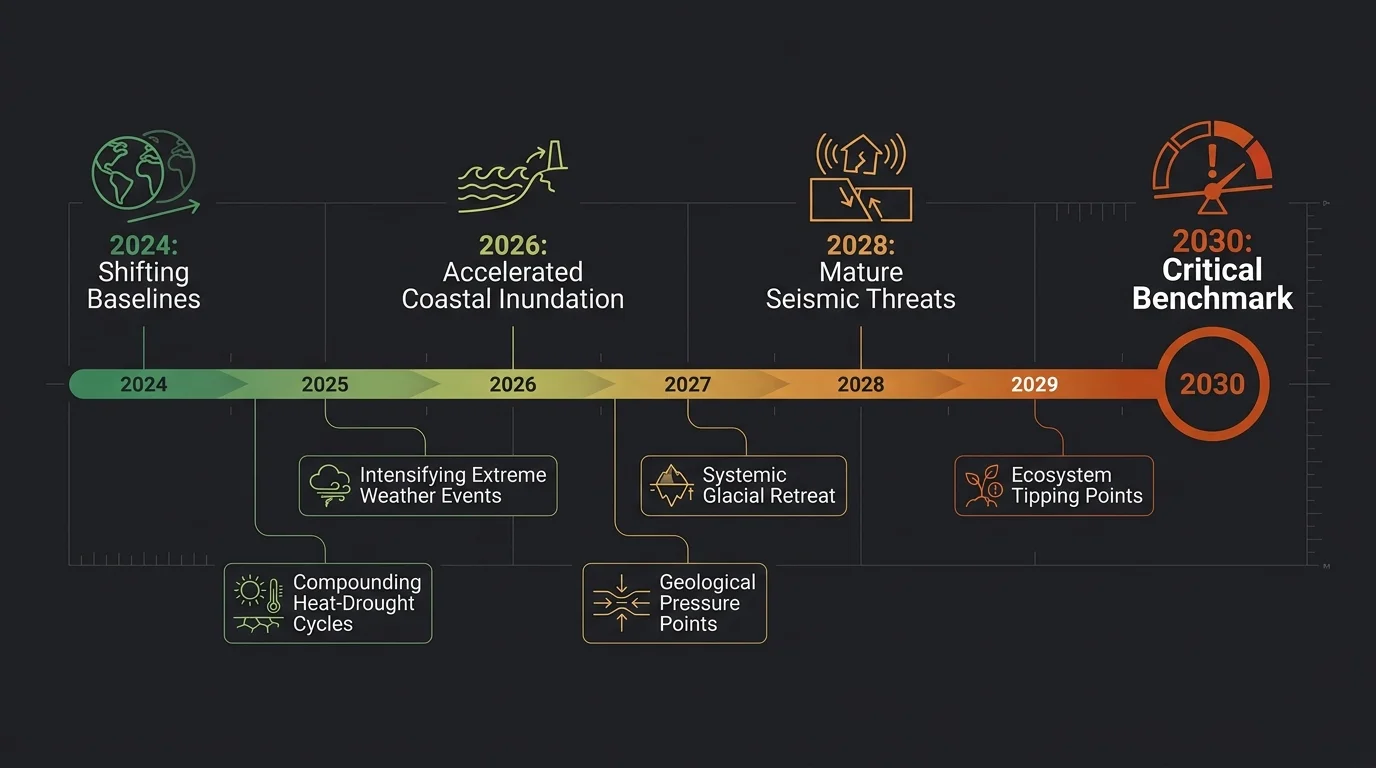
To grasp the reality of upcoming natural threats, you must examine the chronological progression of a modeled catastrophic event. Emergency management agencies utilize precise scenario planning to anticipate how a major disaster will unfold by 2030. The timeline of a projected megathrust earthquake and subsequent tsunami provides a clear framework for understanding key moments, official alerts, and vital response milestones.
The Pre-Event Phase (Years 2026 to 2029). During this period, the scientific consensus hardens around specific vulnerabilities. Monitoring agencies deploy dense networks of deep-ocean sensors and GPS stations along high-risk fault lines. While earthquakes cannot be predicted to the day, researchers identify an alarming increase in subtle seismic swarms and tectonic strain, prompting federal agencies to issue long-term readiness mandates. Local governments utilize this window to aggressively update building codes and refine mass evacuation routes.
Zero Hour: The Rupture. The disaster initiates deep beneath the ocean floor. Instantly, advanced seismic networks detect the primary P-waves. An automated ShakeAlert is broadcast directly to millions of cell phones and municipal warning systems, providing residents with roughly forty-five to sixty seconds of actionable warning. This crucial window allows you to drop, cover, and hold on; automated systems power down commuter trains, shut off regional gas mains, and pause industrial manufacturing lines to prevent secondary fires.
Minutes 5 to 30: The Tsunami Threat. Following five minutes of terrifying, intense shaking, the displacement of the ocean floor generates a massive tsunami. Coastal sirens activate immediately, initiating the official evacuation protocols planned during the pre-event phase. Residents in inundation zones have less than twenty minutes to reach high ground on foot, as roads become impassable due to liquefaction and debris. The initial wave strikes the coastline, bringing a devastating surge equivalent to the worst historic hurricanes, instantly obliterating low-lying infrastructure.
The Golden 72 Hours: Search and Rescue. In the immediate aftermath, the focus shifts entirely to preserving human life. Federal disaster declarations are signed within hours, mobilizing military and specialized urban search and rescue task forces. However, due to the complete destruction of regional transportation networks, initial response heavily relies on local community emergency response teams. During this critical window, survival depends largely on the emergency supplies you have stored and the immediate actions taken by neighborhood volunteers to extract trapped individuals.
Weeks 1 to 4: Secondary Impacts and Aftershocks. As the immediate crisis stabilizes, the reality of secondary impacts sets in. The region experiences hundreds of notable aftershocks, some strong enough to collapse structures already weakened by the main quake. Millions remain without power, potable water, or sanitation services. The response milestones during this month focus on establishing vast humanitarian supply chains, deploying mobile water purification units, and containing hazardous material spills resulting from compromised industrial sites along the flooded coast.
Months 1 to 6: Sustained Recovery. The timeline transitions from immediate emergency response to long-term recovery and remediation. Temporary housing communities are constructed for hundreds of thousands of displaced residents. Officials begin the arduous process of clearing millions of tons of hazardous debris. It is during this phase that local and federal governments evaluate the root causes of specific infrastructure failures, laying the groundwork for how the region will eventually rebuild to withstand the next inevitable disaster.