Causes & Mechanisms
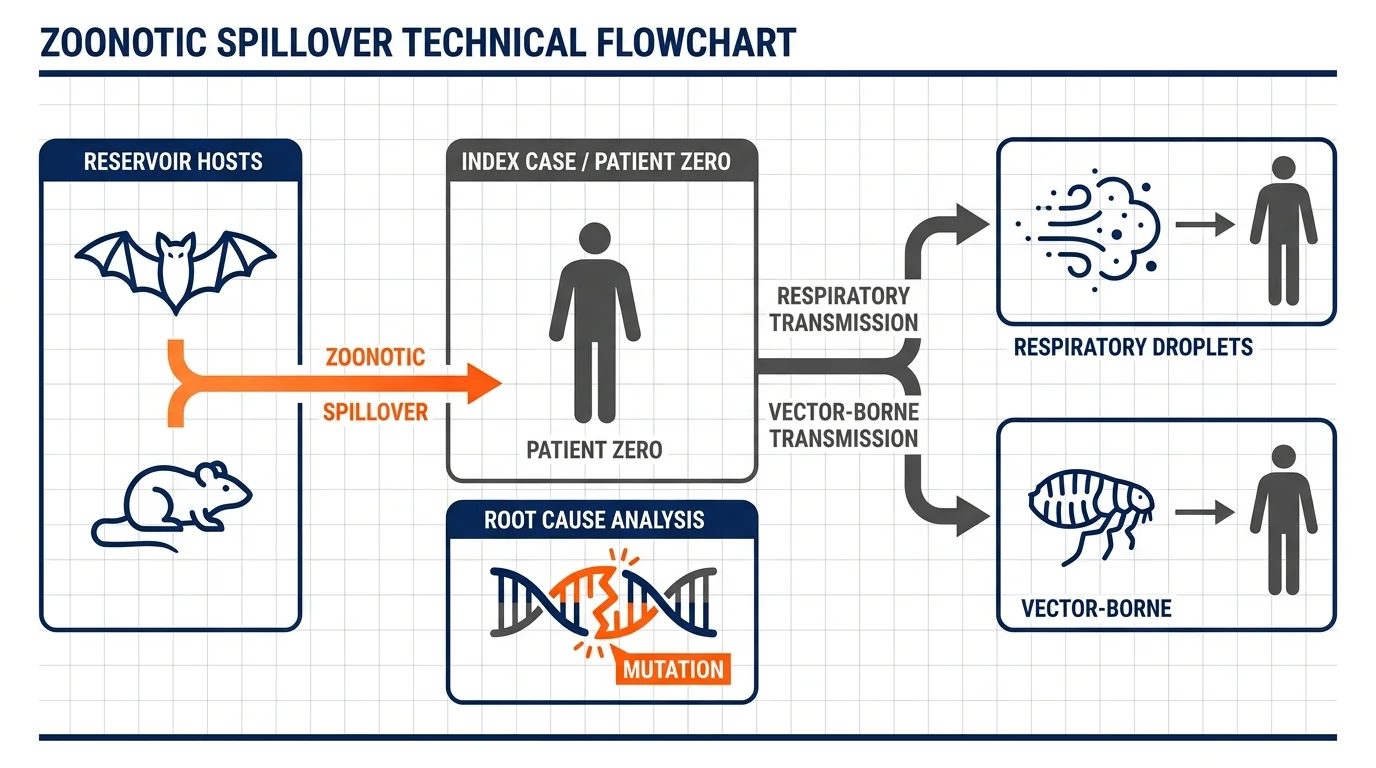
The vast majority of the deadliest outbreaks originate from zoonotic spillover. This biological mechanism occurs when a pathogen naturally circulating in animal populations—such as bats, rodents, or birds—mutates and successfully infects a human host. Epidemiologists perform root cause analysis—a systematic investigative process for identifying the original source of an event—to trace a pandemic back to its index case, or patient zero. By mapping the genetic lineage of a virus, scientists can determine exactly how and where the pathogen crossed the species barrier, which helps authorities implement safety protocols to prevent future occurrences.
Pathogens utilize different transmission vectors to invade new hosts. Respiratory viruses, such as influenza and coronaviruses, primarily spread through airborne transmission and respiratory droplets expelled when an infected person coughs, sneezes, or speaks. Bacterial infections like the bubonic plague rely on vector-borne transmission, where an intermediary organism—such as a flea—transmits the bacteria from a reservoir host into the human bloodstream. Other diseases spread through fomites, which are inanimate objects or surfaces contaminated with infectious agents, or via the fecal-oral route due to contaminated water supplies.
To understand how quickly a pathogen saturates a population, epidemiologists use a mathematical metric known as the Basic Reproduction Number, or R0 (pronounced R-naught). This value represents the average number of secondary infections generated by a single infectious individual in a completely susceptible population. For example, consider a novel respiratory virus with an R0 of 2.0. If you introduce one infected person into a community, that individual infects two others. Those two infect four, who then infect eight, leading to rapid exponential growth. Within just ten transmission cycles, a single case generates over 1,000 new infections. Conversely, public health interventions like quarantines, social distancing, and mask mandates aim to reduce the effective reproduction number below 1.0. When the transmission rate drops to 0.8, every ten infected people only pass the virus to eight others, causing the outbreak to steadily decay and eventually collapse.
Pathogens also evolve through genetic mutation. Viruses continually replicate their genetic material, and transcription errors frequently occur during this process. While most mutations render the virus inert, occasional genetic shifts allow the pathogen to bypass existing immune defenses, increase its transmission efficiency, or cause more severe cellular damage. This rapid viral evolution explains why populations require updated vaccines for seasonal influenza and why pandemics often arrive in devastating, successive waves.