Timeline
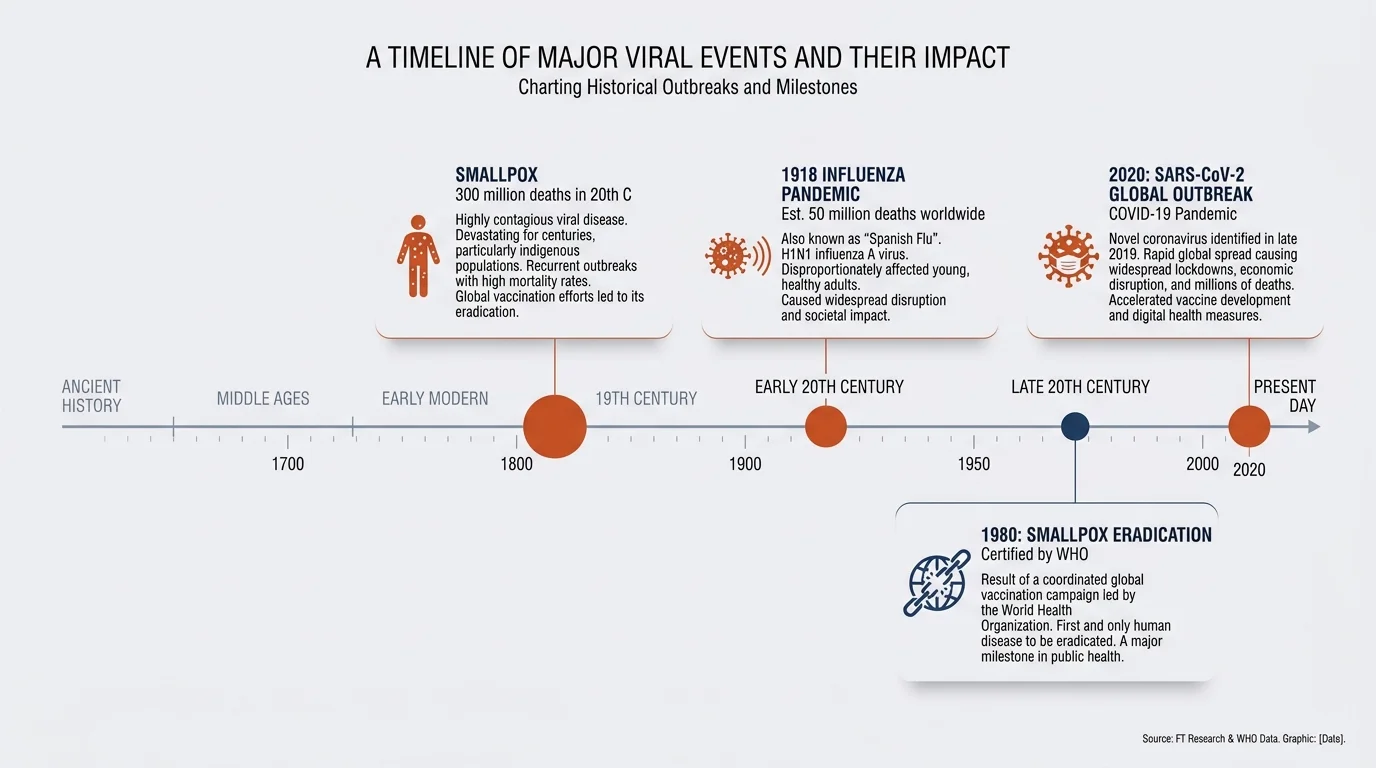
The history of infectious virus outbreaks reveals critical patterns in pathogen emergence, global spread, and human response. By tracing the chronological milestones of widespread viral diseases, you can see how global transportation networks and urbanization accelerate the transmission of deadly pathogens. Tracking these timelines allows epidemiologists to identify the seasonal trends, mutation rates, and intervention failures that turn localized outbreaks into global catastrophes.

5. Influenza A
Influenza A viruses present a persistent, evolving threat due to their unique genetic structure. The virus genome consists of eight separate RNA segments, which allows for two dangerous mechanisms: antigenic drift and antigenic shift. Antigenic drift involves gradual mutations that require annual vaccine updates. Antigenic shift occurs when two different influenza strains coinfect a single host, swapping RNA segments to create a radically new subtype to which humanity has zero immunity. This mechanism drives catastrophic pandemics.
The timeline of the 1918 Influenza pandemic demonstrates the devastating potential of an antigenic shift. In early March 1918, military personnel at Camp Funston, Kansas, reported the first major cluster of severe respiratory illness. The virus traveled alongside troop movements during World War I, spreading across North America and Europe. A mild spring wave gave way to an exceptionally lethal autumn wave starting in late August 1918. The virus triggered massive immune overreactions in young, healthy adults. By the time the pandemic subsided in 1920, the H1N1 strain had infected roughly one-third of the global population and killed an estimated 50 million people. Subsequent shifts caused major, though less deadly, pandemics in 1957, 1968, and 2009, proving that Influenza A remains one of the most prominent world health threats.
6. Human Immunodeficiency Virus (HIV)
The emergence and spread of HIV highlights a slow-moving but relentless timeline. HIV operates as a retrovirus, utilizing an enzyme called reverse transcriptase to transcribe its viral RNA into DNA, which it then integrates directly into the host’s cellular genome. The virus specifically targets and destroys CD4 T-cells, slowly dismantling your immune system over a period of years and leaving you vulnerable to opportunistic infections.
Genetic tracing indicates that HIV spilled over from chimpanzees to humans in Central Africa during the early 20th century, likely through the bushmeat trade. For decades, the virus circulated quietly along emerging transportation routes. The timeline of global recognition began abruptly in June 1981, when public health officials in the United States noted unusual clusters of rare pneumonias and cancers among young men. By 1983, researchers isolated the virus responsible. Throughout the 1980s and early 1990s, HIV was effectively a death sentence. A critical turning point arrived in 1996 with the introduction of Highly Active Antiretroviral Therapy. This breakthrough halted viral replication and transformed HIV from a fatal illness into a manageable chronic condition, though the virus has still claimed more than 40 million lives since the epidemic began.