Lessons & Reforms
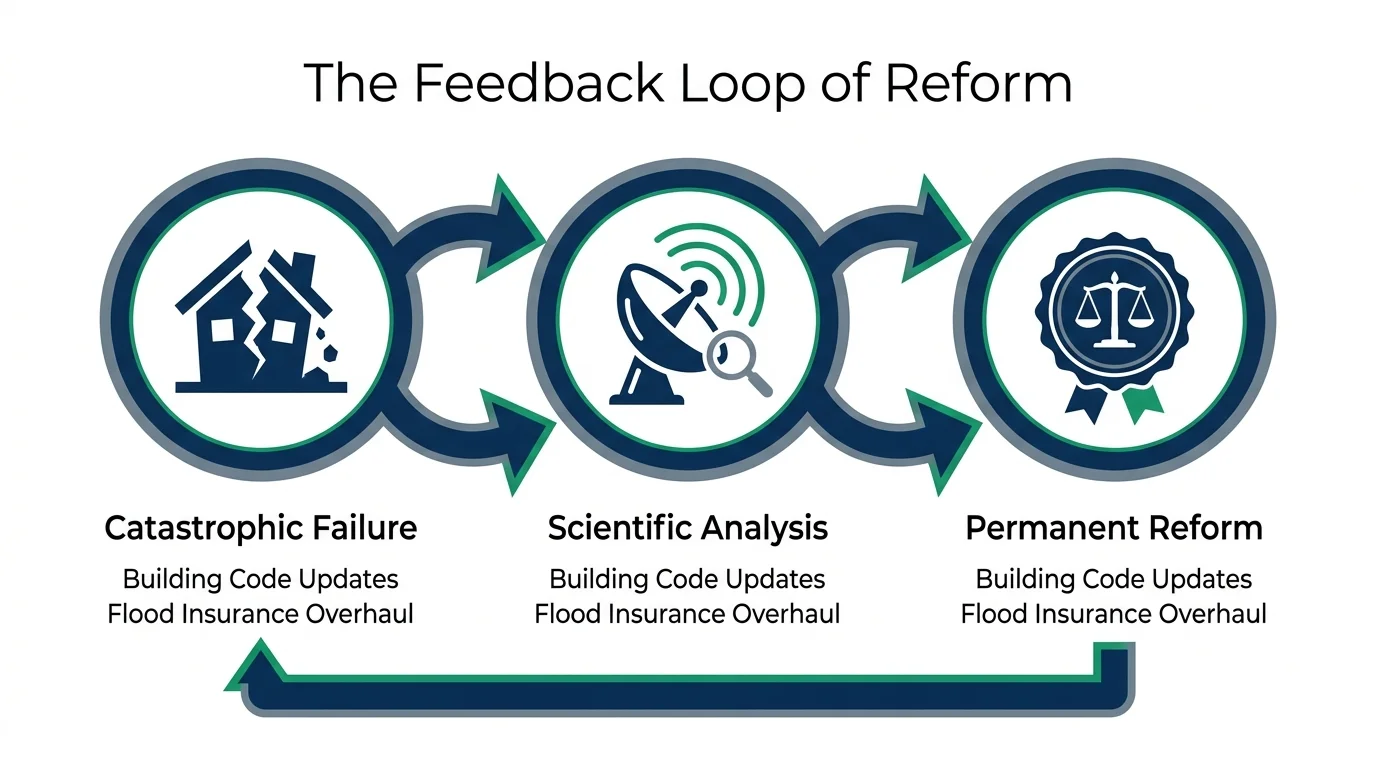
Disasters act as brutal but effective catalysts for policy and engineering reform. You can track the evolution of American safety standards by looking at the specific legislation passed immediately following historic hurricanes and tornadoes. Politicians and engineers implement these reforms to mitigate future economic loss and save lives, though implementing these changes often requires fighting entrenched political and development interests.
To understand how a storm forces structural change, consider this concrete example: The reform of the Florida Building Code after Hurricane Andrew in 1992. Before Andrew, loosely enforced county codes allowed builders in South Florida to use staples to attach roof decking to trusses, and many modern developments lacked proper aerodynamic engineering. When Andrew’s Category 5 winds penetrated these homes, the roofs peeled off instantly, leading to total structural collapse. The resulting $27 billion economic shock pushed the state to create a unified, stringent building code in 2001. The new code required builders to use heavily engineered roofing nails rather than staples, install impact-resistant windows or hurricane shutters, and utilize metal hurricane straps to tie the roof directly to the concrete foundation. Economic studies later showed that homes built under this new code sustained significantly less damage during subsequent storms like Hurricane Irma, proving that upfront economic investment in engineering directly reduces long-term disaster costs.
You can see a similar mechanism of policy reform in federal emergency management following Hurricane Katrina. The delayed and disjointed response to the flooding of New Orleans exposed fatal communication gaps between local, state, and federal agencies. In response, Congress passed the Post-Katrina Emergency Management Reform Act (PKEMRA) of 2006. This act completely reorganized the Federal Emergency Management Agency. While keeping the agency within the Department of Homeland Security, PKEMRA elevated the FEMA Administrator to advise the President directly during active disasters. Furthermore, it explicitly prohibited the federal government from reassigning critical FEMA assets away from an active disaster zone and mandated the creation of highly trained regional strike teams. By formalizing these command structures, the government effectively recognized that administrative bottlenecks cause as much human suffering as the storms themselves.
Protective civil engineering also adapts. Following the 1900 hurricane, Galveston engineers literally raised the entire city’s elevation by pumping millions of cubic yards of sand from the ocean floor, and they constructed a massive 17-foot concrete seawall. After the 1928 tragedy, the Army Corps of Engineers constructed the Herbert Hoover Dike around Lake Okeechobee. These massive public works projects highlight a fundamental reality of American severe weather history: you cannot stop the atmosphere, but you can build a more resilient barrier between natural forces and human economies.